

A structured lash supplier audit checklist gives you the power to make confident decisions when choosing an eyelash factory. You protect your brand by focusing on quality control, traceability, and consistency.
Many B2B eyelash extension supplier evaluation processes reveal frequent issues in factories, such as inconsistent glue or eyelash defects.
| Common Quality Control Issues | Description |
|---|---|
| Inconsistent Glue | Glue batch failures from poor formulation control affect product reliability. |
| Eyelash Defects | Fiber shedding, bent bands, and curl drift often signal process drift. |
| Lack of Batch Testing | Skipping batch tests increases costs and risks for your business. |
Heyme Beauty sets the industry standard with best practices you can trust. Use this checklist at every stage of your supplier evaluation.
Key Takeaways
- Use a structured audit checklist to evaluate eyelash suppliers. This helps ensure quality control and consistency in your products.
- Understand different buyer types in the B2B eyelash market. Matching your business model with the right supplier can enhance your success.
- Prioritize clear communication with suppliers. Providing detailed product specifications leads to accurate quotes and reduces misunderstandings.
- Confirm that sample quality matches bulk production. This prevents discrepancies and protects your brand reputation.
- Implement batch traceability for all products. This ensures accountability and helps resolve issues quickly if they arise.
Channel Fit and Buyer Needs
Identifying Buyer Types
You need to understand the different buyer types in the b2b eyelash industry before selecting a supplier. Each buyer has unique requirements for wholesale eyelash extensions. The following table shows how needs vary across segments:
| Buyer Type | Best Classic Lash Use Case | Recommended Starting Range | Main Risk |
|---|---|---|---|
| Salon owner | Natural sets and daily services | Core curls, medium lengths, practical thickness | Buying rare specs before client demand is clear |
| Lash brand | Starter product line and private label trays | Mixed trays plus selected single lengths | Packaging too many SKUs too early |
| Distributor | Core wholesale stock | High-demand tray specs with clear labels | Large catalog with weak reorder focus |
| Academy/trainer | Training kits and beginner practice | Mixed classic trays and practical curls | Using low-quality trays that hurt the training experience |
| E-commerce seller | Professional tray category | Clear product education and visuals | Selling professional products without enough explanation |
You must match your business model to the right supplier. Manufacturers offer direct control over quality and customization. Wholesalers provide a wide range of wholesale eyelash extensions and established relationships. Distributors simplify logistics and inventory management. Brands deliver consistent quality and reliability.
| Supplier Type | Key Characteristics |
|---|---|
| Manufacturer | Direct control over formulation and quality, competitive pricing, customization options, direct communication. |
| Wholesaler | Convenience of a range of products, established relationships with manufacturers. |
| Distributor | Efficient logistics and inventory management simplify the procurement process. |
| Brand | Assurance of product quality and consistency through established brands. |
Matching Product Range and Private Label Support
You must ensure your supplier can support your product range and private label needs. In the b2b market for wholesale eyelash extensions, factories offer customization options for different buyer segments:
- Custom formulations and packaging for a unique brand identity.
- Flexible manufacturing solutions with low minimum order quantities.
- Premium ingredients for lash health and growth.
- Support for packaging design to match your branding.
You gain a competitive edge when your supplier aligns with your requirements. Heyme Beauty tailors solutions for brands, salons, and new entrants. You receive expert guidance, consistent quality, and scalable support for wholesale eyelash extensions.
You avoid common risks by choosing a supplier who understands your channel fit and buyer needs.
Tip: Always clarify your product specifications and private label goals with your supplier. This ensures you get the right wholesale eyelash extensions for your market and reduces costly mistakes in the b2b process.
B2B Eyelash Supplier Evaluation

Communication and Quotation Process
You need clear and responsive communication when you start your b2b eyelash extension supplier evaluation. Strong factories set themselves apart by providing transparent answers and timely updates. You should expect your factory to discuss every detail, from product categories to packaging needs.
This level of communication helps you avoid misunderstandings and costly mistakes.
You can streamline your b2b buying checks by preparing the following information before you request a quotation:
- Product types (classic lashes, volume lashes, premade fans, cluster lashes, glue, packaging)
- Desired lengths, curls, thickness, and fiber finish
- Quantity for each SKU or tray
- Private label or branding requirements
- Packaging preferences (standard or custom)
- Sample goals and target delivery date
When you provide these details, your factory can give you an accurate quote and realistic lead time. Heyme Beauty’s team uses a step-by-step approach to guide you through the quotation process. You receive clear pricing, production timelines, and advice on how to optimize your order.
This process ensures you get the right products for your market and supports long-term success.
Tip: Always ask your supplier to confirm specifications in writing. This protects your interests and creates a reference for future orders.
MOQ and Sampling Flexibility
You want to test product quality and market fit before committing to large orders. Strong factories understand this need and offer flexible MOQ options. The industry standard for MOQ ranges from 10 to 100 units for small orders.
For standard lash trays without customization, you often see MOQs between 20 and 50 pieces. Bulk orders may require 100 to 1000+ trays, depending on your business scale.
Heyme Beauty stands out by supporting low MOQ and sample-first sourcing. You can start with as few as 50 trays or mix-and-match SKUs to reduce risk. This flexibility allows you to conduct a thorough b2b eyelash extension supplier evaluation and make informed decisions.
Many factories now provide trial orders and sampling programs, so you can check quality, packaging, and consistency before scaling up.
Here’s a quick comparison of typical MOQ and sampling options:
| Order Type | MOQ Range | Sampling Allowed | Mix-and-Match SKUs |
|---|---|---|---|
| Standard Trays | 20-50 pieces | Yes | Yes |
| Custom Packaging | 50-100 pieces | Yes | Yes |
| Bulk Orders | 100-1000+ | No | No |
You gain a competitive advantage when your factory supports your growth with practical MOQ and sampling flexibility. This approach reduces inventory risk and helps you build trust with your supplier.
Heyme Beauty’s commitment to factory support and transparent processes makes your b2b buying checks efficient and reliable.
Note: Always clarify sampling policies and minimum order requirements before you finalize your order. This step ensures you avoid surprises and maintain control over your purchasing process.
Lash Supplier Checklist for Factory Process
Handmade Workflow Consistency
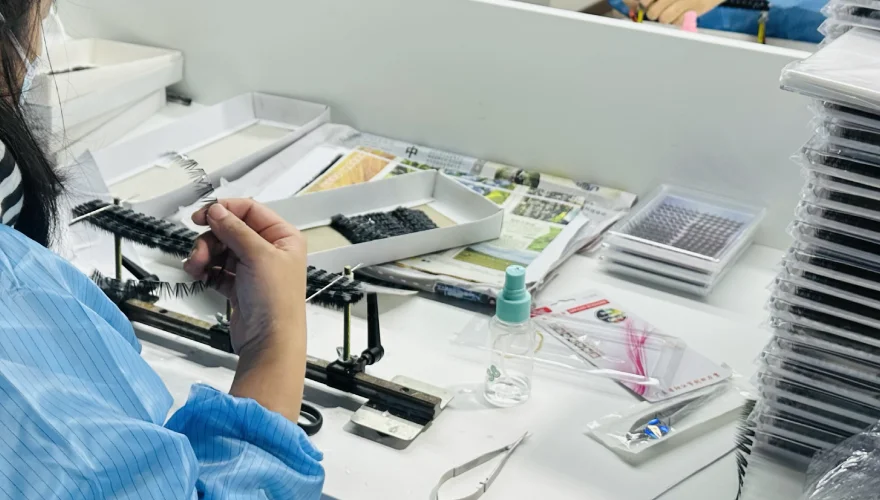
You need to focus on workflow consistency when you audit a lash supplier checklist. Handmade lashes require precise steps at every stage. You must check if the factory maintains clean workstations and follows strict protocols.
Consistent environments help workers produce extensions with uniform curl, length, and thickness. You protect your brand by verifying that each batch of lashes meets the same quality standards.
Heyme Beauty sets a benchmark for workflow consistency. The team organizes workstations to minimize contamination and error. You see a clear separation between raw materials, production, and finished goods. This structure prevents mix-ups and ensures that every tray of lashes matches your specifications.
You should ask your factory to show its process documentation. Written procedures help workers repeat tasks accurately and maintain quality.
You gain confidence when you see a factory process that supports repeatable results. The lash supplier checklist should include checks for workstation cleanliness, batch tracking, and step-by-step production guides.
You reduce risk by confirming that the factory uses standardized tools and materials for all extensions. Consistency in the handmade workflow leads to fewer defects and higher satisfaction for your clients.
Tip: Request photos or videos of the production area. Visual evidence helps you verify that the factory follows best practices for workflow consistency.
Worker Training and Scalability
You must evaluate worker training and scalability as part of your lash supplier checklist. Factories need to scale up production without sacrificing quality. You should look for signs that the factory invests in ongoing training and hires certified lash technicians.
This approach ensures that every worker can produce lashes that meet your standards.
A scalable factory process includes:
- Hiring additional certified lash technicians to maintain quality as order volumes grow.
- Providing ongoing training to reinforce consistency in application techniques and sanitation.
- Developing standard operating procedures for client communication and booking processes.
You should check if the factory uses written training manuals and schedules regular skill assessments. These steps help workers stay updated on the latest techniques for extensions. You protect your business by choosing a supplier who can handle large orders without losing quality or consistency.
Heyme Beauty demonstrates strong scalability by expanding its workforce and updating training programs as demand increases. You benefit from a factory that adapts quickly and maintains high standards for every batch of lashes.
The lash supplier checklist should include questions about worker certification, training frequency, and process documentation.
Note: Always ask your supplier how they manage new hires and training during peak seasons. This information helps you predict future performance and avoid delays.
You build a reliable partnership when you select a factory that prioritizes workflow consistency and scalable training. The lash supplier checklist guides you to ask the right questions and verify that your supplier can support your growth with quality extensions.
Quality Control and QC Systems

Product Specification Checks
You must prioritize quality control when you select an eyelash supplier. Leading factories use a structured QC checklist template to ensure every product meets your standards. You should expect measurable checks at each stage of production. These checks cover curl, length, thickness, and fiber finish.
The table below shows the most common quality control aspects that top factories use:
| Quality Control Aspect | Description |
|---|---|
| Curl consistency | Ensures the curl shape is uniform across products |
| Length accuracy | Verifies that the length of lashes meets specifications |
| Thickness and fiber texture | Checks the thickness and quality of the fibers used |
| Base quality | Assesses the strength and narrowness of the lash base |
| Fan structure | Evaluates symmetry, spacing, and alignment of lash fans |
| Color richness | Confirms deep black color without fading |
You should look for factories that use incoming material inspection, in-process quality checks, and final product inspection. These steps help you control every detail. For example, factories trim lash fibers to exact lengths and use custom rods for curl setting.
Controlled heat treatment locks in curl and sterilizes the lashes. Before shipment, every tray goes through a final QC inspection under magnification. This process identifies defects like color variation or curl drift.
Heyme Beauty’s QC system includes batch testing and traceability. Each batch undergoes tensile strength and curl retention analysis. You receive documentation for every lot, which supports issue resolution and long-term quality control.
Sample-to-Bulk Consistency
You need to confirm that sample quality matches bulk production. Many buyers face issues when bulk orders do not match approved samples. A strong qc checklist template helps you avoid this risk. You should verify measurable checks for curl, length, and thickness in both samples and bulk shipments.
Factories that value quality use premium materials and precise manufacturing. They check for curl memory, softness, and fiber uniformity. You should expect the same level of QC inspection for every order size.
Heyme Beauty’s team documents every step, from incoming material control to final QC. This approach guarantees consistency and protects your brand reputation.
Tip: Always request batch records and QC reports for both samples and bulk orders. This practice ensures you receive the quality you approved and supports traceability if issues arise.
You build trust with your supplier when you see a transparent QC system. Consistent quality control and detailed documentation give you confidence in every shipment.
Lash Supplier Audit Checklist for Traceability
Batch and Lot Labeling
You need strong traceability to protect your brand and resolve issues quickly. Batch traceability starts with consistent labeling on every inner pack and carton. When you visit a factory, check if each eyelash tray and shipping box has a clear lot number.
This number links the product to its production date, raw materials, and quality control records. Consistent labeling helps you track products from the factory floor to your customer’s hands.
Heyme Beauty uses a robust traceability system that includes batch traceability at every stage. You see lot numbers on all packaging, making it easy to identify specific batches if a problem arises.
This approach supports fast recalls and targeted investigations. You avoid confusion and delays because every product can be traced back to its origin.
| Core Quality Processes | Description |
|---|---|
| Incoming inspection | Every raw material delivery is checked against defined specifications before release. |
| In-process controls | Critical parameters are monitored and documented during production. |
| Final inspection | Finished products undergo comprehensive testing before approval. |
| Stability testing | Long-term tests confirm product shelf life and safety. |
| Data integration | An integrated data architecture ensures that all relevant information is up to date and stored centrally. |
| ERP systems | Modern ERP systems integrate all relevant business processes, ensuring consistency of data. |
Documentation and Lot Identification
You need detailed documentation to support traceability and batch traceability. Factories should keep records that link each lot to its production and QC results. If you ever face a market issue, you can quickly identify the affected lot and review its history. This process reduces risk and builds trust with your customers.
Heyme Beauty’s traceability system uses digital records and ERP integration. You benefit from fast access to batch traceability data and QC reports. The following methods help ensure lot identification:
- Batch traceability with lot control on all inner packs and cartons
- Records that connect lots to production and QC results
- Quick lot identification if a market issue occurs
You gain peace of mind when your supplier uses consistent labeling and thorough documentation. Traceability links every product to its quality checks, making your supply chain safer and more reliable.
Sample Evaluation and Approval
Fast Sampling and Mixed SKUs
You need a supplier who values speed and flexibility in the sampling process. Quick sampling helps you make decisions faster and reduces risk in your supply chain. Top eyelash factories, including Heyme Beauty, understand that you want to test multiple SKUs before placing a bulk order.
You can request a mix of styles, curls, and lengths in one sampling batch. This approach allows you to compare products side by side and select the best options for your market.
Here is the average turnaround time for eyelash sample requests among leading suppliers:
| Stage | Timeline |
|---|---|
| Sample | 7–14 days |
You should always include sampling as a core part of your supplier audit. When you audit a factory, ask about their ability to handle mixed SKUs and their process for keeping sample quality consistent.
Heyme Beauty supports fast sampling and mixed SKU requests, which give you flexibility and control. You can use approved sample references to set clear expectations for your bulk orders.
Tip: Request clear communication on sampling lead times and ask for updates during each stage of the process. This step keeps your audit on track and prevents delays.
Preventing Sample-to-Bulk Differences
You must ensure that the quality of your samples matches the quality of your bulk production. Many buyers face issues when there are differences between the sample and the final product. You can prevent these problems by following a structured audit checklist and using approved sample references as your standard.
To avoid discrepancies, follow these recommended procedures:
- Test samples like real products, focusing on pickup, softness, curl hold, glue contact, and finished appearance.
- Compare samples with the supplier’s bulk standard to ensure consistency.
- Ensure the supplier conducts raw material inspections, in-process checks, and final pre-shipment inspections.
You should include these steps in your audit to protect your brand reputation. Heyme Beauty uses a strict audit process to guarantee that every batch matches your approved sample references. You gain confidence when you see that sampling results align with bulk shipments.
Consistent audit practices help you build a reliable supply chain and maintain high standards for your clients.
Note: Always document your sampling results and keep them as part of your audit records. This practice supports traceability and helps resolve any future quality concerns.
Packaging, Shipping, and Compliance
Protective Packaging Standards
You must prioritize packaging that protects your eyelash products throughout international shipping and handling. Heyme Beauty invests in packaging upgrades that support both long-distance transport and private label branding. You benefit from solutions that combine durability, presentation, and cost control.
- Tuck-end folding cartons provide strong protection and resist crushing during transit.
- Matte lamination keeps packaging free from scuffs and maintains a premium appearance.
- A hero effect, such as a foil logo or spot UV, adds visual impact for retail or ecommerce.
- Paperboard cradles or custom tray fits prevent movement and damage inside the box.
- Stabilizing inserts, including paper pulp, foam, EVA, or PET, secure lash trays and enhance presentation.
When you select packaging, you should consider several key factors:
- Protection—Packaging must withstand repeated handling and long shipping routes.
- Shelf impact—Design should help your product stand out in stores or online.
- Speed—Packaging should allow for quick packing without leaving fingerprints or scratches.
- Cost control—You need predictable unit costs and options for low minimum orders.
- Sustainability—Choose eco-friendly materials that still meet durability standards.
Heyme Beauty’s packaging solutions address these needs, ensuring your lashes arrive safely and look professional.
Regulatory and Claims Management
You must follow strict compliance standards when marketing eyelash products. The FDA does not approve cosmetic products or their claims before they reach the market. You hold responsibility for ensuring your products are safe and your claims are accurate.
Every statement about your lashes must have credible scientific support.
Avoid using phrases like “FDA-approved,” “medical-grade,” or “hypoallergenic” unless you have proper documentation and regulatory review. You should conduct regular legal checks and have marketing materials reviewed by someone with regulatory expertise.
This approach protects your brand from legal risks and builds trust with your customers.
Tip: Always verify your claims and keep records of supporting evidence. This practice helps you maintain compliance and strengthens your reputation in the market.
Reorder Documentation and Consistency
Approved Specs and Templates
You need to lock in quality and consistency with every reorder. Approved specs serve as your blueprint for future orders. When you work with Heyme Beauty, you receive written confirmation of every detail—curl, length, thickness, and packaging. This documentation ensures your next shipment matches your expectations.
Heyme Beauty uses templates that capture all critical information. These templates include approved samples, packaging files, and quality references. You can answer key questions before reordering:
| Specification Aspect | Details |
|---|---|
| Approved Sample | Lash extension samples for wholesale and private label orders |
| Documentation Purpose | Ensures consistency in quality and specifications for future orders |
| Reorder File Questions | Which sample was approved? What exact length range was approved? Was the tray mixed length or single length? Which curl and thickness were used? Which tray card or packaging version was approved? What quantity was ordered first? Which lengths sold fastest? Which lengths should be added, removed, or converted to single-length trays? |
You gain control over your supply chain when you use approved specs and templates. This process reduces errors and helps you scale your business with confidence.
Standardized Reorder Formats
You build strong supplier relationships by using standardized reorder formats. These formats create predictable ordering patterns and improve transparency. Heyme Beauty’s system generates clear notifications and automated communication, so you always know what to expect.
| Benefit | Description |
|---|---|
| Predictable ordering patterns | More consistent and timely order placement allows suppliers to better plan capacity, inventory, and production schedules. |
| Improved transparency | Automated communication and system-generated notifications create clearer expectations and reduce misunderstandings between manufacturers and suppliers. |
| Stronger long-term partnerships | Reliable, data-driven workflows foster trust and stability, supporting healthier, long-term supplier relationships. |
You support long-term growth by documenting every reorder. Standardized formats help you track lot sampling, compare batches, and check for consistency in curl, thickness, and strip behavior. This approach ensures your brand delivers the same quality every time.
Tip: Save your reorder templates and approved specs for every SKU. This habit makes future orders faster and more accurate.
Conclusion
You secure reliable supplier selection and protect your brand reputation by using a comprehensive lash supplier audit checklist. Heyme Beauty’s approach delivers measurable quality control, traceability, and clear documentation. The checklist covers key aspects:
| Aspect | Benefit |
|---|---|
| Factory process | Consistent handmade workflow |
| QC inspection | Verified product quality |
| Batch traceability | Accountability for every production lot |
| Packaging proof | Maintains brand image |
Next steps for B2B buyers include:
- Aligning tray names and SKU codes for private label lash extensions.
- Verifying quality control checks before reordering.
- Submitting your lash demand and specifications for a personalized audit.
FAQ
What documents should I request during a factory audit?
You should request process flow charts, QC checklists, batch records, and sample approval forms. These documents help you verify consistency and traceability.
How do I confirm a supplier’s private label capabilities?
Ask for samples of previous private label projects. Review their packaging options and customization processes. You can also request a list of supported branding services.
What is the typical lead time for bulk eyelash orders?
Most factories deliver bulk eyelash orders within 15–30 days after sample approval. Lead times may vary based on order size and customization.
How can I ensure consistent quality with every reorder?
Use approved specs, reorder templates, and written confirmations. Always compare new shipments to your reference samples and QC reports.
Why is batch traceability important for eyelash suppliers?
Batch traceability links each product to its production and QC records. This system helps you resolve issues quickly and maintain accountability throughout your supply chain.