

If you are launching or growing a lash brand, you have probably run into the same problems. Suppliers ask for huge minimum orders. They take weeks to reply. They do not offer real customization.
This guide is for brand owners who want to sell cluster lashes under their own name. We will walk through what cluster lashes actually are, how minimum order quantity works, what styles you can customize, how packaging affects your brand, and how long production takes.
By the end, you will know exactly what to ask a manufacturer before you place your first order.
What Type of Lashes Is This Article About?
This article covers cluster lashes. Cluster lashes are small groups of lashes that come in little bunches. You apply them under your natural lashes, not on top. They have become extremely popular in the DIY and at-home beauty market.
Where They Fit
Strip lashes are easy to put on but only last one day. Professional extensions look great but require salon visits and cost more money. Cluster lashes sit in the middle. They give a fuller look than strip lashes, last several days, and do not require a professional to apply them.
From a Factory Perspective
For manufacturers, cluster lashes are one of the fastest growing B2B categories. Brands want them because customers buy them again and again. The demand comes from emerging beauty brands, Amazon sellers, lash startups, and private label businesses.
What Are Private Label Lash Clusters?
Private label lash clusters are cluster lashes made by a factory but sold under your brand name. You choose the style, the packaging, and the label. The factory handles production and quality control.
Your customers see your logo, your packaging, and your brand story. They never see the factory name. That is the point of private label. You build your brand. The factory builds the product.
Why They Are Trending
The DIY beauty boom changed how people buy lashes. During lockdowns, many women learned to apply cluster lashes at home. They realized it saves time and money compared to salon extensions. That habit stuck. Now the cluster lash category keeps growing every year.
Regular vs Self-Adhesive Lash Clusters
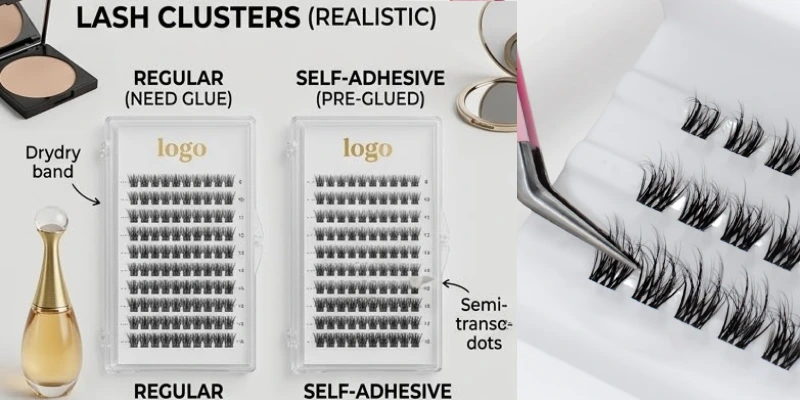
Not all cluster lashes work the same way. There are two main types. Each serves a different customer.
Regular Clusters
Regular clusters require separate glue. Customers apply a bond, place the cluster, then seal it. This type lasts three to seven days with proper care. Customers can reuse the same clusters twenty to twenty-five times if they clean them after each use.
Regular clusters work well for experienced users and lash artists. They offer the best value over time.
Self-Adhesive Clusters
Self-adhesive clusters come with glue dots already applied to the band. Customers open the package and stick them on. No extra glue needed. They last one to three days and can be reused one to three times before the glue dots stop working.
Self-adhesive clusters are great for beginners, travel, and customers who want something quick and easy. They cost less per set but have lower margins because customers buy them more often.
Which One Should Your Brand Offer?
Many successful brands sell both. Self-adhesive clusters bring in new customers who are trying cluster lashes for the first time. Regular clusters keep those customers coming back with better value and longer wear.
Here is a quick comparison.
| Feature | Regular Clusters | Self-Adhesive Clusters |
|---|---|---|
| Extra glue needed | Yes | No |
| Wear time | 3 to 7 days | 1 to 3 days |
| Reuses | 20 to 25 times | 1 to 3 times |
| Best for | Experienced users, salons | Beginners, travel, quick use |
| Packaging | Standard blister | Sealed blister (glue protection) |
| Price per set | Higher | Lower |
Minimum Order Quantity Explained
Minimum order quantity is often the first question brand owners ask. It determines how much cash you need to start and how much risk you take.
Typical Industry MOQ
Most lash factories ask for one thousand pairs per style as a minimum. That works for big brands but kills small startups. If you want three styles, you order three thousand pairs. That is a lot of inventory before you know if your customers like the product.
A Better Starting Point
Some manufacturers offer lower minimums. Starting from fifty pairs per style is possible with the right partner. That lets you test the market, get customer feedback, and reorder best sellers before committing to large quantities.
Low MOQ works especially well for new brands and Amazon sellers who want to validate demand first.
Why MOQ Matters for Your Business
MOQ affects three things. Cash flow comes first. A lower MOQ means less money tied up in inventory. Product testing comes second. You can sample a few styles, see what sells, then order more of the winners. Risk control comes third. If a style does not sell, you are not stuck with thousands of unsold units.
MOQ Differences Between Regular and Self-Adhesive
Regular clusters have lower MOQ requirements because the production process is standard. Fifty to one hundred pairs per style is common.
Self-adhesive clusters need higher MOQ, usually two hundred to five hundred pairs per style. The glue dot application requires special equipment and has minimum batch sizes.
Custom Lash Styles You Can Offer
Customization is the main reason brands work with a manufacturer instead of buying ready-made stock. You want something that looks different from what every other brand sells.
Style Options
You can choose from several style families. Wispy styles have separated spikes that create a feathery look. Natural styles mimic real lashes. Volume styles pack more fibers for a fuller appearance. Manga and anime styles have defined spikes that create a doll-like effect.
Technical Specifications
These are the numbers behind each style.
Density is measured in D numbers. Three D to five D gives a natural look. Six D to eight D is medium volume. Ten D to twelve D is high volume. Fifteen D and above is mega volume. Higher D numbers use more fibers per cluster.
Length ranges from eight millimeters to twenty-five millimeters. Most brands use mixed trays with shorter lashes for the inner corner, medium in the middle, and longer on the outer corner.
Curl determines how much the lash lifts. J curl is almost straight. B curl is a slight lift. C curl is the most common natural lift. CC curl is more open. D curl and DD curl give dramatic lift. L curl bends at the end like a professional extension.
Thickness usually sits between 0.03 millimeters and 0.10 millimeters. Thinner fibers look more natural. Thicker fibers create more volume.
Stem or band comes in different forms. Ultra fine clear bands are almost invisible. Flat black bands create extra lift. Pre glued dot bands come ready for self adhesive clusters.
Material Options
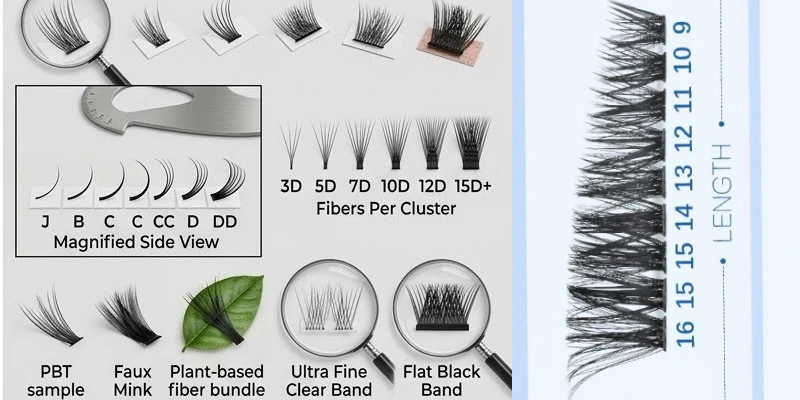
Three materials dominate the market.
PBT fiber is the most common choice. It is vegan, holds curl well, and costs less than other options. Faux mink feels softer and looks more like real hair. Plant based fibers appeal to eco conscious customers who want natural materials.
Mapping Support
You do not have to figure out length placement on your own. A good manufacturer helps with mapping. Cat eye mapping puts longer lashes at the outer corner. Doll eye mapping puts longer lashes in the center. Wispy mapping alternates short and long spikes throughout the lash line.
The right partner helps you create exclusive designs that other brands cannot copy.
Styles Available for Self-Adhesive Clusters
Self adhesive clusters work best with three D to eight D styles. Heavier ten D and above styles may have adhesion problems because the weight pulls on the glue dots. Always test heavier styles before committing to a large order.
Custom Packaging Solutions
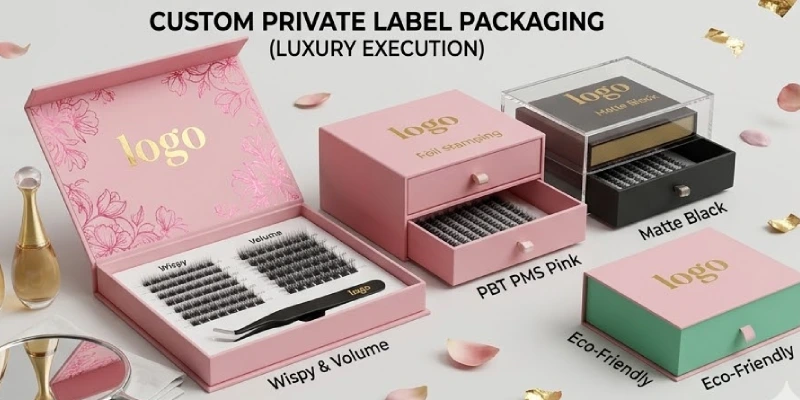
Packaging is not just a box. It is the first thing your customer touches. Good packaging makes your brand look professional. Bad packaging makes good lashes feel cheap.
Packaging Types
Blister packs are the most common option. They are cost effective and protect the lashes during shipping. Magnetic closure boxes feel premium and work well for gift sets. Drawer and slider boxes offer a modern unboxing experience. Eco friendly packaging appeals to customers who care about sustainability. Clear acrylic cases let customers see the product before opening.
What You Can Customize
Logo printing comes in several methods. Foil stamping looks luxurious. Silkscreen is durable and clean. Digital print works for full color designs.
Custom colors match your brand identity exactly using PMS matching. Insert cards can include your brand story, application instructions, and aftercare tips.
Special Packaging for Self-Adhesive Clusters
Self adhesive clusters need sealed blister packs or foil bags. The seal keeps glue dots from drying out before the customer opens the package. Regular blister packs do not work. Always ask your manufacturer about moisture barrier packaging for self adhesive products.
Design Support
Many manufacturers offer free design help. They cannot replace a professional graphic designer, but they can turn your rough ideas into print ready files. Ask what design services come included before you sign anything.
Lead Time and Shipping
Speed matters in the beauty business. Trends change fast. If your product takes three months to arrive, you might miss the moment.
Standard Lead Times
Stock samples usually take three to five days. Custom samples need five to seven days because the factory has to make new molds or adjust production lines.
Bulk production for regular clusters runs seven to ten days. Full OEM with new styles and custom packaging takes ten to fifteen days. Self adhesive clusters also need ten to fifteen days because of the glue dot process.
Shipping Options
Express shipping through DHL, FedEx, or UPS takes three to five days. Air freight takes five to ten days. Sea freight takes twenty to thirty five days and works best for large orders where speed matters less than cost.
Why Lead Time Matters
Fast turnaround means faster market entry. If you reorder best sellers, you want them back in stock before you run out. A manufacturer with short lead times helps you keep your inventory lean.
Quality Control
Quality problems destroy brands. One bad batch can fill your reviews with complaints about lashes that fall apart or cause irritation. Good manufacturers take quality seriously at every stage.
The Inspection Process
Raw materials get checked before production starts. During production, workers test curl retention to make sure the fibers hold their shape. Every single cluster gets a visual inspection before packing. Random samples go through adhesion and durability testing.
Self adhesive clusters need extra checks. The glue dots must stick properly and stay sticky through the product shelf life.
Certifications
Certificates matter if you sell in the United States or Europe. CE, FDA registration, TUV, and ISO 9001 are the common ones. Cruelty free and vegan certifications assure customers that no animals were used. MSDS documents come with adhesives and other chemical products.
Ask for copies before you place your first order. A legitimate manufacturer provides them without hesitation.
Defect Guarantee
Most professional factories guarantee a defect rate below 0.3 percent. If a batch fails your inspection, they replace it. Make sure this policy is in writing before you pay.
Why Choose a Professional Manufacturer
Experience shows up in the details. A factory with ten years in the business has seen every problem and fixed it. They know which curl works for which eye shape. They know how to pack lashes so they arrive looking perfect.
What to Look For
In house production means no middlemen marking up prices. You pay factory direct rates. Strict quality control catches problems before they reach you. Trend knowledge helps you launch styles that are selling right now, not styles that were popular last year.
One stop supply matters more than you think. A manufacturer who also provides tools, adhesives, and packaging saves you from managing five different suppliers.
Who Is This Service For
Private label lash clusters work for several types of businesses.
Lash startup brands get their first product in the market without committing to massive inventory. Amazon and Shopify sellers test new styles with low financial risk. Beauty distributors add cluster lashes to their existing product lines. Salon owners launch their own products for retail. Influencers create their own lash brand as a merchandise line.
If you fit any of these categories, private label cluster lashes are worth considering.
Common Mistakes to Avoid
Brand owners make the same mistakes again and again. Here are the ones to watch for.
Ordering before testing samples. Never place a bulk order based on photos. Get samples in your hands first.
Underestimating shipping costs and duties. International shipping adds up. Customs duties surprise many first time buyers. Ask for a delivered price including all fees.
Ignoring certifications. If your target market requires CE or FDA approval, make sure your product has it.
Choosing the lowest price. Cheap lashes fall apart. Customers notice. You lose repeat business.
Not planning reorder lead time. If you sell out and reordering takes three weeks, you lose sales. Order before you run out.
Storing self adhesive clusters wrong. Heat and moisture ruin glue dots. Store sealed product in a cool, dry place.
FAQ
What is the MOQ for private label lash clusters?
It depends on the manufacturer and the product type. Regular clusters can start at fifty pairs per style. Self adhesive clusters usually need two hundred to five hundred pairs per style.
Can I mix different styles in one order?
Yes. Most manufacturers allow mixed styles within the same total order quantity.
Can I customize D number, curl, and length?
Yes. These are the most common customizations. Provide your specifications and the factory produces samples for approval.
Do you offer free packaging design?
Many manufacturers include basic design support. Ask before you commit.
How long does production and shipping take?
Production takes seven to fifteen days depending on complexity. Express shipping takes three to five days. Sea freight takes twenty to thirty five days.
Can beginners start a lash brand?
Yes. Low MOQ makes it possible to start small, learn the market, and scale up.
What is the difference between regular and self adhesive clusters?
Regular clusters need separate glue and last several days with multiple reuses. Self adhesive clusters have glue pre applied, last one to three days, and have fewer reuses.
Can I get free samples?
Many factories offer free samples of stock styles. You pay shipping. Custom samples usually have a small fee that gets refunded on your first bulk order.
Are your lashes cruelty free and vegan?
Most PBT and faux mink lashes are cruelty free. Ask your manufacturer for certification if this matters to your customers.
What payment terms do you accept?
Common options include T/T bank transfer, PayPal for small orders, and Letter of Credit for large contracts. Net thirty terms may be available for established partners.
Conclusion
HeyMe Beauty has spent years perfecting cluster lash production. We know what works and what fails. Our low MOQ helps you test the market. Our custom styles and packaging give you real differentiation. Our lead times keep your business moving. You focus on building your brand. We focus on making lashes that sell. Talk to us about your next collection.