

Let’s be honest. Lash retention problems don’t usually come from one big mistake. They come from small things that quietly go wrong.
A client walks in two weeks later, and half the extensions are gone. The glue was good. The technique was solid. So what happened?
In many cases, the answer is surprisingly simple: the lashes were never properly cleaned to begin with.
Oil, dust, leftover makeup—these tiny contaminants sit at the base of natural lashes. If they’re not removed completely, adhesive bonding becomes weak. And weak bonds don’t last.
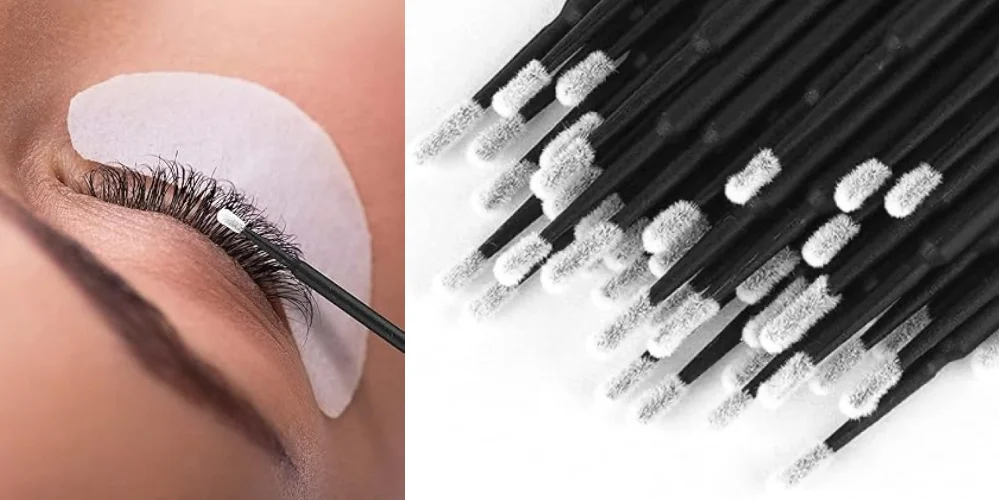
Now here’s where things get interesting.
Many lash artists still rely on regular cotton swabs for pre-treatment. It seems harmless. Cheap, easy, always available. But cotton sheds fibers. It absorbs too much liquid. And worse, it spreads product unevenly.
That’s where micro swabs come in.
They’re not just smaller tools. They’re precision instruments designed for one purpose—control. And once you start using them properly, the difference in retention is hard to ignore.
What Makes a Professional Micro Swab?
At first glance, a micro swab doesn’t look revolutionary. A thin stick. A tiny tip. Nothing fancy.
But the real value is hidden in the details.
Lint-Free Tip
This is non-negotiable.
Unlike cotton, a professional micro swab uses a tightly bonded, lint-free material. No loose fibers. No fluff. Nothing that can get caught between lashes or interfere with adhesive.
Because even a single fiber trapped at the lash base can weaken the bond. It’s subtle—but it matters.
Non-Absorbent Head
This is where things shift from “tool” to “efficiency upgrade.”
A standard cotton swab absorbs liquid like a sponge. Most of your primer or remover ends up inside the swab instead of on the lash.
Micro swabs behave differently.
They hold liquid on the surface, allowing precise placement exactly where it’s needed. The result?
- Less product waste
- Better control
- More consistent application
In fact, many professionals report saving up to 50% of their liquid products after switching.
Flexible Neck
Eyes aren’t flat surfaces. Anyone who has worked on inner corners knows this.
A rigid tool forces awkward angles. A flexible one adapts.
Most professional micro swabs feature a bendable neck that can be adjusted up to 90 degrees. This allows access to tight spaces without compromising comfort or precision.
It’s a small feature—but it solves a very real problem.
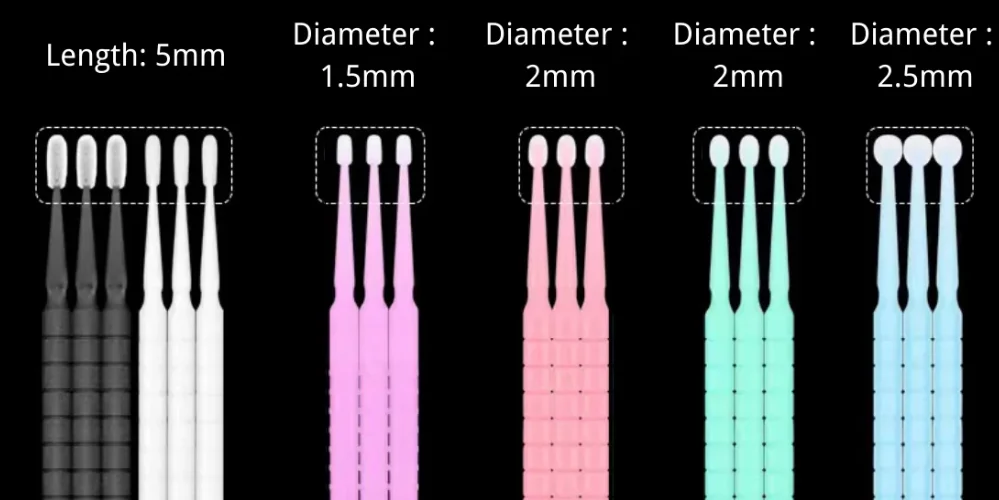
Color-Coded Sizes
Not all tasks require the same size.
Micro swabs typically come in multiple tip sizes:
- Ultra-fine – for detailed work and tight spaces
- Fine – general application
- Regular – broader coverage
Color coding makes it easy to identify the right tool instantly. No guessing. No slowing down.
Top 4 Critical Applications in Lash Extensions
A good tool proves its value through use. And micro swabs? They show up at every stage of the lash process.
Pre-Treatment Cleaning
This is where retention begins—or fails.
Natural lashes carry oils from the skin, residue from skincare products, and microscopic debris. These contaminants create a barrier between the lash and adhesive.
Using a micro swab, you can target the lash line directly. Not just the surface, but the tiny gaps between lashes.
The difference is noticeable. Lashes feel cleaner. Adhesive bonds better. Retention improves.
It’s not dramatic. It’s precise.
Adhesive Management
During application, glue control is everything.
Too much adhesive leads to clumping. Too little leads to weak bonds.
A micro swab allows you to remove excess glue instantly, right at the moment it matters. No smearing. No disturbing nearby lashes.
Just a quick, controlled adjustment.
Safe Removal
This is one area where precision isn’t just about results—it’s about safety.
Remover products can be strong. If they spread beyond the intended area, they can irritate the skin or even reach the eyes.
Micro swabs allow targeted application. You apply remover exactly where needed, and nowhere else.
That control reduces risk significantly.
And in this industry, safety isn’t optional.
Post-Application Correction
Even the most experienced lash artists encounter small imperfections.
A tiny glue spot. A slight misplacement. A detail that needs refining.
Instead of reworking an entire section, a micro swab lets you correct the issue with minimal disruption.
It’s efficient. Clean. Professional.
Why Choosing the Right Supplier Matters
Not all micro swabs are created equal.
From a distance, they may look identical. But manufacturing quality tells a different story.
Medical-Grade Materials
High-quality micro swabs use materials that are safe for skin contact. No harsh plastics. No questionable fibers.
This matters because lash work happens close to sensitive areas. Even minor irritation can affect the client experience.
Consistency in material quality builds trust—both for the artist and the client.
Consistency in Production
A loose tip. A weak bond. These aren’t just inconveniences—they’re risks.
Reliable manufacturers use processes like ultrasonic bonding to ensure the tip stays firmly attached. Every time.
No surprises mid-application.
And when you’re working on a client, predictability matters more than anything.
Bulk Supply & OEM Options
For salons and distributors, customization becomes important.
Color variations. Packaging styles. Private labeling.
A strong supplier can offer flexibility without compromising quality. That’s how brands grow—by controlling both performance and presentation.
Professional vs. Cheap Improvised Tools
At first glance, regular cotton swabs seem like the economical choice.
They’re cheap. Easy to find. Familiar.
But the real cost isn’t on the receipt.
Hidden Costs of Cheap Tools
Cotton swabs absorb too much liquid. That means more primer used. More remover wasted.
They also shed fibers, which can interfere with bonding and lead to poor retention. Poor retention leads to unhappy clients. And unhappy clients don’t come back.
Suddenly, the “cheap” option becomes expensive.
Time Efficiency Gains
Time is another factor.
Professional micro swabs allow faster, cleaner application. No need to re-clean. No need to fix fiber-related issues.
Over the course of a day, this can save 10 to 15 minutes per client.
Multiply that across a full schedule, and the difference becomes significant.
FAQ
1. Can micro swabs be bent easily?
Yes. Most professional micro swabs feature a flexible neck that can be adjusted to suit different angles and eye shapes.
2. Are they hygienic for professional use?
Absolutely. They are designed for single use and are often packaged in clean, sealed environments to maintain hygiene.
3. Will the tip fall off during use?
High-quality micro swabs use advanced bonding techniques, such as ultrasonic welding, to ensure the tip remains secure.
4. Do they really save product?
Yes. Their non-absorbent design ensures liquids stay on the surface, reducing waste significantly.
5. Are different sizes necessary?
Different sizes improve precision. Smaller tips are ideal for detailed work, while larger ones handle broader areas.
6. Can beginners benefit from using micro swabs?
Definitely. In fact, beginners often see quicker improvements in control and consistency when using the right tools.
Conclusion
In lash artistry, it’s easy to focus on the visible elements—extensions, styles, techniques.
But often, the real difference lies in the tools you don’t think twice about.
Micro swabs fall into that category.
They don’t draw attention. They don’t seem complex. Yet they influence every stage of the process—from preparation to finishing touches.
Better cleaning leads to stronger bonds. Better control leads to cleaner work. And cleaner work leads to better retention.
It’s a chain reaction.
And once you see it, it’s hard to go back.
Because in the end, perfect lash retention isn’t just about skill. It’s about precision. And precision starts with the smallest tools.