

Cluster lashes have quietly become a core product for many lash brands. Not because they’re flashy, but because they work for real people—beginners who can’t apply strip lashes, DIY users who want extension-like results at home, and salons looking for faster service. They’re also a natural fit for private label brands.
But here’s the thing most new brand owners miss: choosing a cluster lashes manufacturer is completely different from buying a few trays from a vendor. Once your logo is on that box, every single quality issue becomes yours. If clusters fall apart during pickup, if the curl changes after shipping, if the tray layout looks like it was thrown together, customers won’t say “bad factory.” They’ll say “bad brand.”
So don’t start by asking for the lowest price. Start by asking: can this factory help me make a stable, repeatable, sellable product that won’t embarrass my brand six months from now?
First, Get Clear on What You Actually Need
Before you even email a factory, figure out where you are as a business.
If you’re just testing the market, you probably need ready-made styles in small quantities. Fast feedback, low risk. If you already have a brand, you need custom trays, logo boxes, clear lash maps, and a reorder system that doesn’t break between batches. If you sell DIY lash extension kits, you also need bond, seal, tweezers, spoolies, and packaging that holds everything together.
These are not the same conversation.
A beginner brand needs flexibility. A growing brand needs consistency—same curl, same length, same packaging color, same everything. A distributor needs production capacity and batch control.
Do yourself a favor before asking for quotes: write down your target market, preferred styles, quantity, packaging needs, private label requirements, and whether you’re selling single trays or full kits. This one step will save you weeks of back-and-forth with suppliers who were never a good fit.
Start With the Lashes Themselves, Not the Packaging
Packaging sells the first order. The lashes themselves decide whether there’s a second one.
When you get samples, don’t just look at photos. Photos lie constantly. You need to touch the product and run it through a few dead-simple tests.
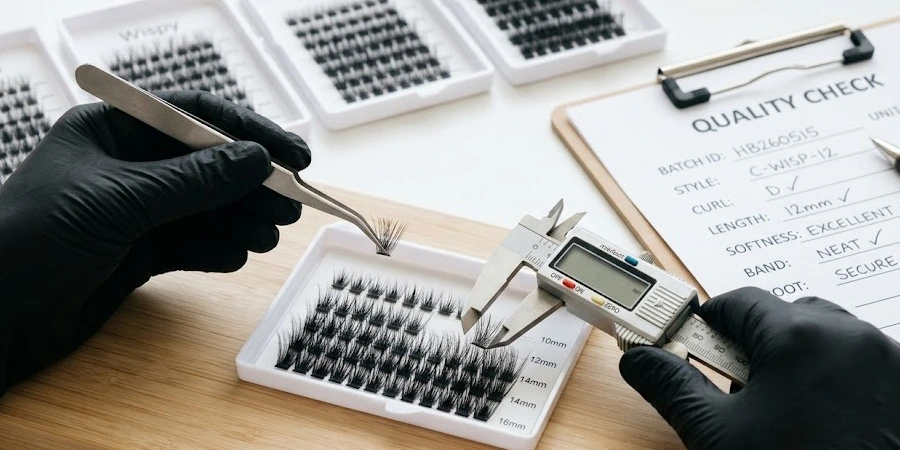
Softness. Good cluster lashes feel soft and flexible, not like plastic strips. If they feel stiff, they’ll be uncomfortable to wear under natural lashes, and beginners will hate them.
Curl consistency. Lay out several trays side by side. Do the curls actually match? They don’t need to be mathematically perfect, but if one tray clearly looks different from another in the same batch, that’s a problem.
Length accuracy. Grab a ruler or caliper. Randomly pick a few clusters and measure them. A tolerance of plus or minus one millimeter is fine for most lash products, but what you really want is consistency within the same style. If a 12mm row looks almost as long as a 14mm row, customers will absolutely notice.
Durability. Take tweezers and pick up the same cluster ten times in a row. Does it hold together? Does the root start splitting? If it falls apart during normal pickup, imagine how it will survive actual use.
The band area. The base should be neat—not bulky, not sharp, not covered in visible glue. For invisible band clusters, this is especially important. A thick root is harder to apply and less comfortable to wear.
Tray layout. Open the tray. Does it look organized? Are the rows straight? Are lengths clearly labeled? A messy tray layout makes your product look cheap before the customer has even tried it.
These checks take ten minutes. But they immediately tell you whether a factory actually understands quality or just wants to move boxes.
The Real Risk Is Batch Consistency
Here’s the mistake that kills lash brands slowly.
The first sample looks great. You place a bulk order. Everything goes fine. Then you reorder a few months later, and something is different. The curl is slightly off. The softness changed. The lashes feel heavier.
Your repeat customers notice immediately. They don’t know it’s a factory issue. They think your brand lowered its standards.
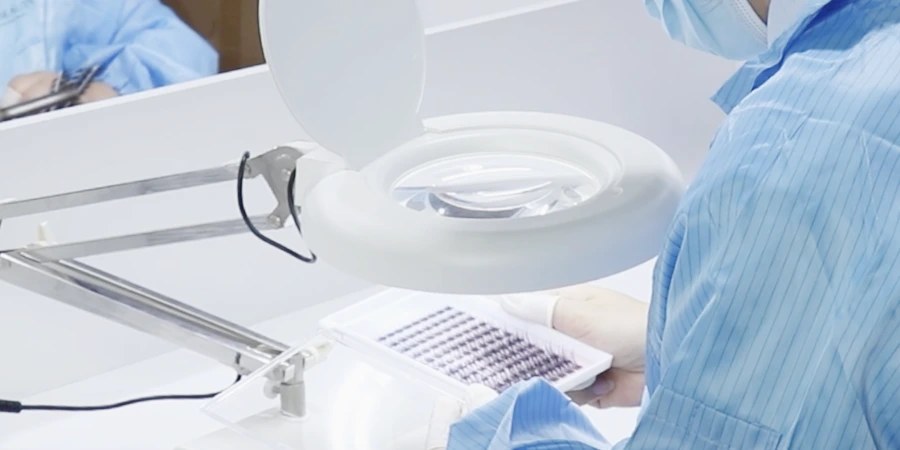
Before you commit to bulk production, ask the factory how they control batch consistency. Do they keep a confirmed sample as the reference for every reorder? Can they send pre-production photos or videos before mass production? Do they actually check length, curl, root condition, and tray layout before packing? What happens if the received goods don’t match the approved sample?
For a private label brand, a confirmed sample isn’t a suggestion. It’s the contract. The factory should never change materials, curl, tray design, or packaging without your approval.
Don’t Chase Every Style at Once
A good manufacturer will have a wide range: natural clusters, wispy, manga, cat eye, doll eye, brown lashes, invisible band, pre-glued, full DIY kit styles. That’s great for your long-term options.
But a new brand launching fifteen SKUs is a recipe for inventory hell.
Start smaller. One natural daily style. One wispy best-seller. One cat eye. One manga or spiky look. If your audience leans soft, add brown clusters. If they want convenience, consider pre-glued—but only after proper testing.
A serious manufacturer will recommend styles based on your market, not just dump a catalog on you.
Customization Should Actually Help You Sell
Private label isn’t just slapping a logo on a box. Real customization solves real problems for your customers.
Maybe that means a specific curl, length mix, cluster width, or lash map. Maybe it means a tray layout that makes sense for beginners, with clearly mixed lengths and simple instructions. Maybe it means packaging that explains application clearly because your customers are first-timers.
When you talk to a factory, ask what can be changed at stock MOQ versus what requires custom MOQ. A printed label or box is usually easy. A new lash map, special fiber, new tray mold, or custom kit structure takes more planning.
And ask about hidden costs upfront: design fees, sample fees, printing plate fees, mold costs, revision fees. And whether any of those get refunded or deducted after a bulk order. Factories that avoid this conversation are often the ones where fees magically appear later.
Pre-Glued Clusters Are a Different Animal
Pre-glued cluster lashes sound perfect for beginners. No separate glue, easy to apply.
But from a brand owner’s perspective, they are significantly riskier than regular clusters.
The adhesive layer is sensitive to storage temperature, humidity, packaging seal, and shelf life. If the glue dries out, gets too sticky, or gets contaminated during shipping, the customer experience is ruined.
Before ordering pre-glued clusters, ask the factory hard questions: Does the adhesive stay stable after transportation simulation? Is the package properly sealed to protect the glue? What’s the shelf life? Does heat or humidity affect performance? Can you provide ingredient or safety documents? Should you include storage instructions on the box?
For pre-glued products, packaging is not a design exercise. It’s product protection. A bad seal can kill your product before it’s even opened.
If you’re a new brand, start with regular clusters. Get your footing. Then consider pre-glued once you understand your market and your supplier’s real capability.
MOQ and Lead Time Need to Fit Your Business, Not Your Wishlist
Low MOQ sounds great. But it’s only useful if it matches how you actually sell.
Stock styles usually have lower MOQ and faster turnaround. Good for testing. Private label packaging bumps MOQ up because printing and packaging production have minimums. Fully custom styles push it higher again.
You also need clear timing for every stage: sample prep, packaging proof, bulk production, inspection, shipping.
And don’t just ask how fast they can ship. Ask what could delay the order. The honest answers are usually: artwork changes, logo color confirmation, material shortages, peak season, or repeated sample revisions.
For a lash brand, running out of your best seller during a campaign is way more expensive than paying a slightly higher unit price. Late restocking kills momentum and customer trust.
Packaging Has to Work for Retail
Pretty packaging is nice. But packaging has real jobs.
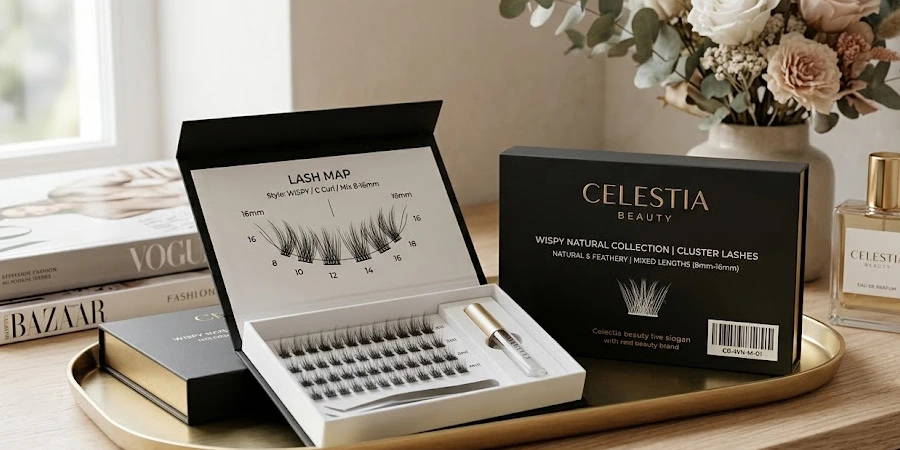
It has to protect the lashes during shipping. It has to clearly communicate the style and length. It has to support your brand identity. And it has to actually work for where you sell—Amazon, Shopify, salon retail, wholesale.
Check the details: Is the logo printing clean? Does the box actually protect the tray? Are length and style names easy to read at a glance? Is there space for barcodes, ingredients, instructions, or distributor information if you need it? If you’re selling kits, does everything stay in place when the box is shaken?
Get packaging samples or mockups before you confirm bulk production. A small mistake on a box becomes a very expensive mistake when you’ve printed ten thousand of them.
Don’t Ignore Compliance Until the Last Minute
Compliance is boring until it stops your shipment at customs or gets your product pulled from a marketplace.
For lash products alone, regulations are relatively light. But if your line includes bond, seal, remover, or any cosmetic-related items, you enter a different world.
Depending on your market, you may need MSDS, ingredient information, safety test reports, heavy metal testing, or formaldehyde-related reports. For Europe, cosmetic products may involve CPNP. For the US, buyers may ask about FDA-related compliance.
A professional manufacturer won’t replace your legal responsibility, but they should be able to provide basic documents and answer material questions clearly. If they can’t explain what materials are used or whether glue-related products have safety information, walk away before placing a large order.
Judge the Factory by How They Solve Problems
Every production run has small problems. The difference between a good factory and a bad one is how they handle them.
A reliable factory confirms details before production. They send samples or photos when something changes. They tell you honestly if there’s a delay. They catch mistakes before shipment—like a logo color being slightly off or a tray layout not being clean enough.
You can’t see this on a price list. But you can learn a lot during sampling. If a supplier is vague, slow, or careless during sample discussion, bulk production will be painful.
Watch for These Warning Signs
| Warning Sign | What It Actually Means |
|---|---|
| Price is way below normal market rates | Likely lower-quality materials, inconsistent curl, or poor root construction. Someone has to cut costs. |
| Supplier can’t show real product photos or samples | They may be a middleman without actual production control, or the product doesn’t exist as shown. |
| Supplier avoids quality questions | They don’t have a QC process or don’t want you to look too closely before ordering. |
| MOQ, lead time, or packaging costs are unclear | Hidden fees or unrealistic promises. A serious factory gives clear numbers. |
| Product pictures look copied from other brands | The supplier doesn’t have their own product line. What you receive may look completely different. |
| Communication is slow or confusing | Bulk production will be worse. Sampling is the easiest part of the process. |
| Supplier cannot support private label | You cannot build a brand with them. You will always be selling someone else’s stock product. |
| Supplier promises everything too quickly without asking details | They haven’t thought through your actual needs. Problems will appear during production, not before. |
FAQ
1. What styles can I sample first?
You can choose from our six most popular lines: natural, wispy, manga, cat eye, doll eye, and brown. If you’re not sure which one fits your market, just tell me who your customers are—daily wear, beginner DIY, or salons—and I’ll recommend 2–3 styles that actually make sense to sample. We don’t want you testing randomly.
2. Do you keep an approved sample as the production standard?
Yes. Once you sign off on a sample, that becomes the only standard for every single bulk order after that. We keep a sealed master sample in our QC room. Before every production run, we pull it out and compare curl, length, lash tip shape, and root construction. No approval from you, no production.
3. What’s your acceptable tolerance for length and curl?
Length: ±1mm is the industry standard, but we keep it tighter at ±0.8mm internally. Curl: we don’t give a number because different fibers and diameters hold curl differently. Instead, we use visual matching against the approved sample under the same lighting. If it doesn’t look identical, it doesn’t ship.
4. How do you test if clusters fall apart during pickup?
We use tweezers to pick and release the same cluster 10 times in a row. If the root splits, if any fibers come loose, or if the cluster loses its shape, the entire batch gets flagged. We also do a short simulation of what a beginner would do—picking, adjusting, repositioning. We don’t want your customers to be the first ones to find a weak cluster.
5. What’s your MOQ for stock trays versus private label?
For stock styles (our existing trays with your label on the box): MOQ is 200–500 trays per style, depending on the tray type. For full private label packaging (custom box, custom tray insert, logo everywhere): MOQ is usually 1,000–2,000 trays per style. For fully custom lash styles (your own curl, map, mix): we can talk at 3,000+.
6. What fees exist for samples, packaging, printing, or revisions?
Samples: we charge a small sample fee plus shipping. That fee is fully refundable when you place a bulk order. Packaging and printing: we charge one-time plate fees for boxes and inserts—usually 20–40 per design.(Refund of Design Fees for Orders Over 200 Boxes) No hidden monthly fees. Revisions: first round of changes is free. If you keep changing artwork or lash specs after we’ve already started tooling, we’ll be honest about extra costs before moving forward.
7. Can I see packaging mockups before production?
Absolutely. You will see digital mockups first. Then, before we print thousands of boxes, we send you a physical pre-production sample of the packaging. You approve the actual box in your hands before we run the full order. No surprises.
8. What documents can you provide for lashes and glue-related items?
For lashes alone: basic material declaration. For glue-related items (bond, seal, remover): MSDS, ingredient lists, and stability test reports upon request. We do not provide legal compliance certifications that replace your importer responsibility—but we give you the raw documents your compliance team or retailer will ask for. If you need heavy metal or formaldehyde testing, we can arrange third-party testing at cost.
9. How long does production take after packaging approval?
Stock styles without custom packaging: 7–12 business days. Private label packaging: 15–25 business days after packaging approval, depending on box complexity. Fully custom lash styles: add another 10–15 days for curl and tray development. The clock starts only after you say “yes” to the final sample and packaging proof.
10. How do you handle quality issues after delivery?
If something is wrong on our end—wrong curl, wrong length, damaged trays, printing errors—we cover replacement or refund. No arguing. If the issue is within tolerance but doesn’t feel right to your customers, we’ll work with you on a solution: partial credit, discounted reorder, or adjustments for the next batch. We don’t disappear after payment. A bad batch hurts your brand, and your brand hurting eventually hurts us. That’s not how we stay in business.
Conclusion
Choosing a cluster lashes manufacturer isn’t about finding the cheapest price or the lowest MOQ. It’s about reducing risk.
The right factory helps you control quality, packaging, reorder consistency, compliance, and delivery timing. The wrong factory looks cheaper on paper but costs you in returns, bad reviews, and lost customer trust.
For a lash brand, the best manufacturer isn’t the one with the biggest catalog. It’s the one that can help you build a product your customers will actually buy again.
If you’re developing a private label cluster lash line, get clear on your target styles, packaging ideas, quantity plan, and market requirements before you contact anyone. The clearer your plan, the easier it is to find a manufacturer who can truly support your brand.
HeyMe Beauty is an eyelash factory that works with brands on wholesale cluster lashes, private label packaging, custom styles, and DIY lash extension kits. If you’re planning a cluster lash line, you can reach out for samples and packaging options.