

There’s a moment almost everyone has after trying lash clusters for the first time. You look in the mirror and think, “They look good… but something feels slightly off.” Maybe they’re a little too long at the outer corner. Maybe one segment sits wider than your eye shape. Or maybe the overall look feels heavier than you expected.
That’s where trimming comes in.
At Heyme beauty, we manufacture lash clusters at scale, and we also spend a surprising amount of time analyzing why some applications look seamless while others don’t quite sit right. What we’ve learned over the years is simple: trimming isn’t just a small adjustment—it’s often the difference between a natural, customized result and something that feels uncomfortable or artificial.
But trimming also comes with risk. Done incorrectly, it can damage the structure of the cluster, weaken retention, or completely ruin the shape.
So instead of giving you a rigid set of instructions, let’s walk through this from a more practical perspective—how trimming actually works, when it makes sense, and how to do it in a way that respects the design of the lash itself.
Do You Really Need to Trim Lash Clusters?
Not always.
One of the biggest misconceptions is that trimming is a required step for everyone. It depends on how well the lash cluster matches your eye shape and your styling goal.
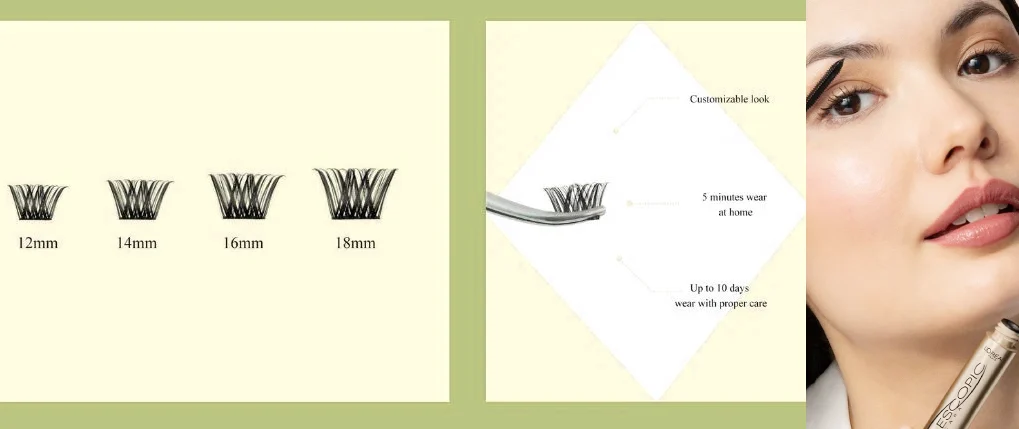
If you’re using well-designed, pre-segmented clusters, especially those developed with multiple length options, trimming might not be necessary at all. In fact, many of our clients prefer clusters that are ready to apply without modification, simply because it reduces error.
However, trimming becomes useful when:
- The cluster feels too long for your natural lash line
- The outer edge extends beyond your eye shape
- The density feels uneven in certain sections
- You’re trying to create a more customized, layered look
In other words, trimming is less about “fixing” the lash—and more about refining the fit.
Understanding the Structure Before You Cut
Before you even think about trimming, it helps to understand how lash clusters are built.
Each cluster consists of two key parts:
- The fiber tips, which create the visible lash effect
- The bonded base, which holds everything together
From a manufacturing standpoint, the base is the most sensitive area. It’s engineered to balance flexibility and strength. If you cut into it incorrectly, you’re not just shortening the lash—you’re weakening the entire structure.
We see this mistake almost every week in customer feedback.
People assume trimming works the same way as cutting strip lashes, but lash clusters behave differently. A small cut in the wrong place can lead to fibers shedding or the cluster losing its shape entirely.
That’s why the rule is simple, but important:
respect the base, and work with the fibers—not against them.
Different Lash Styles Require Different Trimming Approaches
Recommended products
-
Best at Home Cluster Lashes
-

Best at Home Lash Extensions Kit
-

D Curl Pre Cut Cluster Lashes
-

At Home Lash Extension Glue
Not all lash clusters are designed the same way, which means trimming should never be “one method fits all.” The way you adjust a natural style is very different from how you handle a dense or layered cluster.
Let’s break this down in a way that reflects what we see in real production and user feedback.
Natural vs. Volume (Dense) Styles
Natural lash clusters are usually softer, lighter, and more forgiving. If you need to trim them, small adjustments at the tips are often enough. Because the density is lower, even slight changes can noticeably affect the overall look.
Volume styles, on the other hand, are more compact and structured. Trimming them requires a lighter hand. Cutting too much can create uneven density, making the lash appear patchy rather than full.
From our experience, about 7 out of 10 first-time users over-trim volume clusters.
In an attempt to “soften” them, when in reality, it’s often better to choose a lighter style instead.
Single-Layer vs. Multi-Layer Clusters
Single-layer clusters are relatively straightforward. Their structure is simpler, so trimming the tips doesn’t disrupt the overall balance too much.
Multi-layer clusters are more complex. They’re designed to create depth and dimension, with fibers arranged at different heights. If you trim them aggressively, you risk flattening that layered effect.
A better approach with multi-layer designs is to make minimal adjustments—just enough to refine the outline without removing the dimensional structure that gives the lash its character.
Clear Band vs. Black Band Clusters
The band type also plays a role in how trimming should be handled.
Clear band clusters are typically softer and more flexible. They blend easily with the natural lash line, but they’re also slightly more delicate. When trimming, precision matters, because any damage to the base is more noticeable.
Black band clusters are firmer and provide more definition along the lash line. They’re a bit more forgiving structurally, but trimming them incorrectly can create visible gaps or uneven edges.
In both cases, the goal is the same: maintain the integrity of the band while adjusting the visible fibers as naturally as possible.
A Practical Way to Approach Trimming
Instead of thinking of trimming as a “cutting process,” it helps to see it as a fitting process.
Start by observing, not cutting.
Hold the cluster against your lash line without adhesive. Look at how it aligns with your eye shape. Where does it feel too long? Where does it sit too wide? These small observations will guide your adjustments.
When you do trim, work gradually. Small changes are easier to control—and much harder to regret.
And always check the fit again before moving forward. This back-and-forth process might seem slow, but it’s exactly what leads to a natural result.
Common Mistakes We See from a Factory Perspective
After years of manufacturing and reviewing user feedback, certain patterns appear again and again.
One of the most frequent issues is cutting into the base. This usually happens when users try to reduce width by trimming from the wrong angle. The result is a weakened structure that doesn’t hold up during wear.
Another common mistake is over-trimming. It often starts with a small adjustment, followed by another, and then another—until the lash loses its original shape entirely.
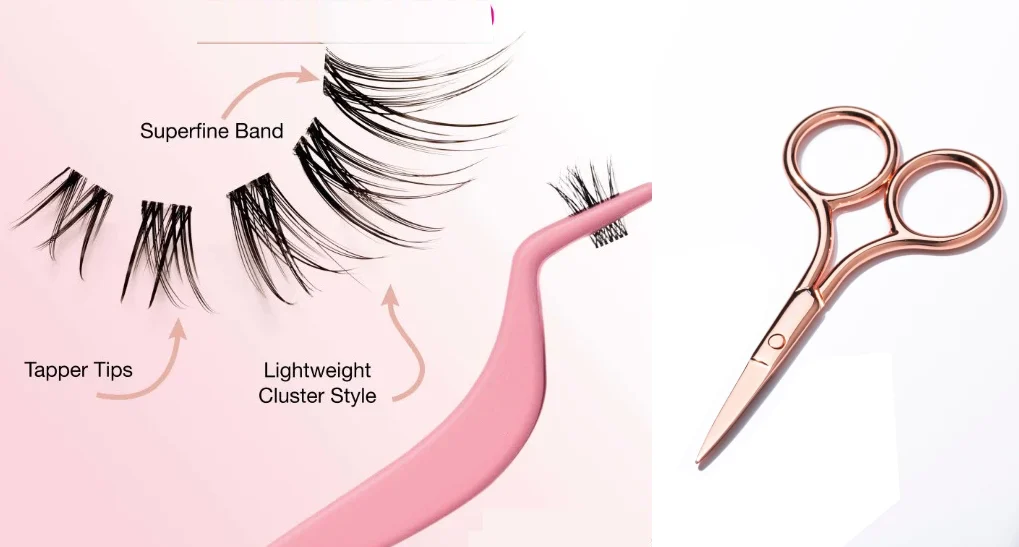
We also see problems caused by improper tools. Dull scissors can fray the fibers instead of cutting them cleanly, which affects both appearance and durability.
These aren’t just small details. They directly affect how long the lashes last and how natural they look once applied.
How Trimming Influences Wear and Retention
When trimming is done thoughtfully, it actually improves performance.
A well-fitted cluster sits closer to the natural lash line, reducing tension on the adhesive. This leads to better retention and a more comfortable feel throughout the day.
But when trimming compromises the structure—especially at the base—the opposite happens. The bond becomes less stable, and the lashes are more likely to lift or fall off prematurely.
This is why trimming should always be approached with intention, not guesswork.
When Trimming Isn’t the Best Solution
Sometimes, trimming isn’t the answer at all.
If the cluster feels consistently too long, it’s often better to switch to a shorter length. If the density feels too heavy, a lighter style will give a more natural result without needing modification.
At Heyme beauty, we’ve focused heavily on designing lash clusters that minimize the need for trimming in the first place. By offering a wider range of lengths, segment sizes, and styles, we make it easier for users to find a close match right out of the box.
Because in the end, the best trimming experience is the one you barely need.
Beyond Trimming: Customizing Your Look
Once you understand how trimming works, it becomes part of a larger idea—customization.
Some users mix different lengths to create a wispy effect. Others combine lighter and denser clusters to build dimension gradually across the lash line.
These techniques don’t rely on cutting alone. They rely on understanding how each piece contributes to the overall look.
And that’s where experience—and product design—come together.
FAQ
Can I trim lash clusters after I’ve already applied them?
Yes, but it’s trickier. When the cluster is already on your lash line, it’s harder to see where the base ends and the fibers begin. If you must trim after applying, use a small curved scissor, look down into a mirror, and trim only the very tips—one tiny snip at a time. But honestly? Trimming before application is much safer and gives you better control.
What happens if I cut into the base?
The cluster will likely fall apart. The base is what holds all the fibers together. Cut into it, and you’ll see fibers start to loosen or shed within a few hours—sometimes immediately. That cluster becomes unusable.
Can I trim lash clusters to make them look more natural?
Sometimes. Trimming the outer corner slightly can soften a dramatic look. But if you want a natural look, you’re usually better off starting with a natural-style cluster rather than cutting down a dense volume style. Trimming changes length, but it doesn’t change density or curl pattern.
What’s the best tool for trimming lash clusters?
A small, sharp, curved scissor made for eyelashes. Not nail scissors. Not kitchen scissors. Dull scissors crush the fibers instead of cutting them cleanly, which creates frayed ends that look unnatural and don’t hold curl as well.
Conclusion
Trimming lash clusters isn’t about correcting a flaw. It’s about refining the fit so the lashes feel like they truly belong to you.
When done carefully, it enhances both appearance and comfort. When done without understanding, it can compromise everything the lash was designed to do.
From a manufacturing perspective, we’ve seen both sides. And that’s why at Heyme beauty, we don’t just focus on how lashes look—we focus on how they perform in real life, in real routines, with real users.
Because the goal isn’t just beautiful lashes.
It’s lashes that work with you, not against you.