

If you’ve ever found yourself struggling to isolate lashes—especially in the inner or outer corners—you’re not alone.
Everything starts fine. Your setup looks clean, your tools are ready… but a few minutes in, things get frustrating. Lower lashes sneak out. Corners feel tight. Your tweezers keep adjusting, but something still feels off.
In many cases, the issue isn’t your skill.
It’s your taping.
Learning how to tape eyes properly for eyelash extensions doesn’t just “help a little”—it completely changes how you work. It gives you space, control, and clarity. And once you get it right, you’ll wonder how you ever worked without it.
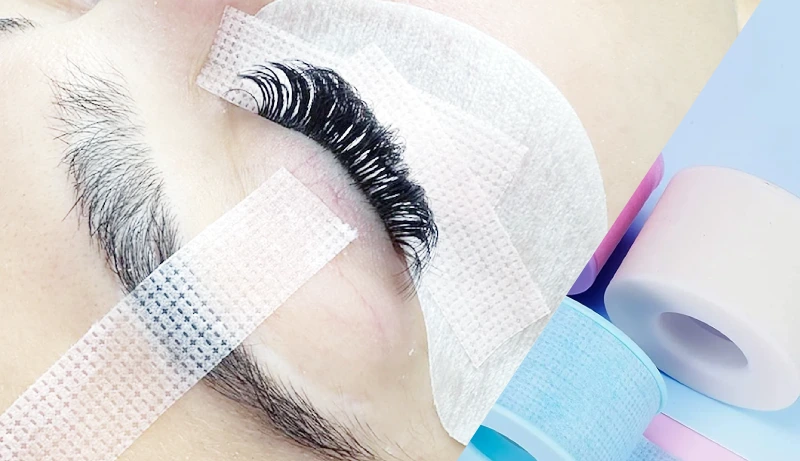
What Eyelash Extension Tape Really Does (Beyond Holding Lashes Down)
At first glance, tape seems simple. You place it under the eye, secure the lower lashes, and move on.
But in practice, it does much more than that.
Good taping quietly shapes your entire working environment. It keeps unwanted lashes out of the way, yes—but it also opens up the lash line, improves visibility, and stabilizes everything so your hands can move with precision.
When taping is done well, you don’t think about it anymore.
You just notice that everything feels… easier.
Why Some Lash Sets Feel Harder Than Others
You’ve probably experienced this:
One client feels effortless. Isolation is clean, placement is smooth, and the set flows naturally.
Then the next client—same technique, same tools—feels twice as difficult.
You slow down. You double-check. You adjust your angle again and again.
What changed?
Often, it’s the way the eye is taped.
Small differences in how the skin is positioned or how the lashes are exposed can completely change your working conditions. And once you start noticing that, taping becomes less of a routine—and more of a strategy.
Choosing the Right Tape (Based on Feel, Not Habit)
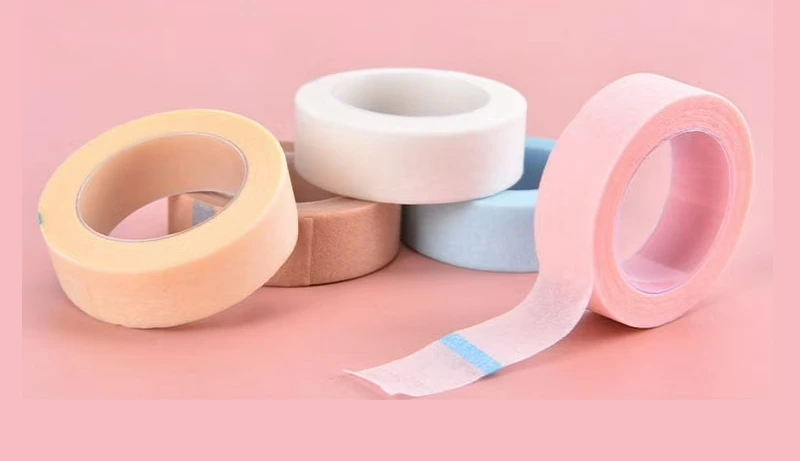
Not every tape behaves the same on the skin, and this is where many lash artists fall into autopilot.
You reach for the same tape every time… even when the client in front of you clearly needs something different.
Some clients have delicate, reactive skin. Others have slightly oily under-eyes where tape doesn’t stick as easily. Some need more flexibility, others need more hold.
A softer, breathable tape works beautifully for sensitive clients, while a slightly stronger tape gives you more control when you need to lift or reposition the eyelid.
The Moment Taping Starts to Matter
Taping doesn’t become important when you place it.
It becomes important when something goes wrong.
When a few lower lashes slip out and attach to your extensions.
When the inner corner feels too tight to work in.
When your isolation starts clean—but slowly loses precision.
That’s when you realize: this isn’t a tweezer problem.
It’s a setup problem.
And setup is something you can control.
Building a Clean Foundation (Without Overcomplicating It)
Start simple.
Place your under-eye pad or base tape just below the lower lash line. Close enough to secure everything—but never so close that it touches the sensitive inner rim of the eye.
Then pause.
Don’t rush into lashing.
Look carefully from different angles. You’ll often notice tiny lashes still escaping—those are the ones that cause issues later. A small strip of tape placed with intention fixes that immediately.
This step takes seconds, but it saves minutes (and frustration) later.
When your base is clean, everything else flows better.
When Basic Taping Isn’t Enough
There’s a point in every lash artist’s journey where basic taping stops being enough.
You start noticing areas that still feel difficult:
- The inner corner feels cramped
- The outer corner loses direction
- Certain lashes stay hidden no matter how you adjust
This is where taping becomes more than preparation—it becomes a tool for control.
Opening Up the Eye: Small Adjustments, Big Impact
Take the inner corner, for example.
It’s one of the most delicate areas, and also the easiest to neglect. When it’s not properly exposed, lashes there either get skipped—or applied without precision.
A gentle outward taping motion can open that space just enough to let you work cleanly.
No force. No tension. Just a slight shift.
Suddenly, what felt crowded becomes manageable.
Now think about the outer corner.
This is where styles are defined—especially for cat-eye or wispy looks. But it’s also where angles become awkward and lashes overlap.
A small piece of tape, placed strategically, stretches that area just enough to give you a better line of sight.
It doesn’t feel dramatic.
But the difference in control is immediate.
The Subtle Art of Lifting (Without Overdoing It)
Lifting the eyelid slightly with tape can completely transform your visibility—especially for hooded or relaxed lids.
But this is where balance matters.
Too little lift, and nothing changes.
Too much, and the eye feels tight and uncomfortable.
The goal isn’t to “pull”—it’s to reposition gently.
When done right, the lash line becomes clearer, your angle improves, and your hands naturally become more precise.
And the client? They shouldn’t feel strained at all.
Why “More Tape” Often Makes Things Worse
It’s tempting to think that adding more tape will solve problems.
In reality, it often creates new ones.
Too much tape can:
- Distort the natural eye shape
- Create uneven tension
- Make the client uncomfortable without obvious signs
The best setups are usually the simplest ones.
A few well-placed strips will always outperform excessive layering.
Learning to Read the Eye in Front of You
No two clients will ever tape exactly the same way.
Some eyes need lifting.
Some need opening.
Some just need clean separation.
The more you practice, the more you start to see what each eye needs—almost instantly.
And that’s when your workflow changes.
You stop reacting to problems… and start preventing them.
The Mistakes You Don’t Notice Until Later
Some taping mistakes don’t show up immediately.
They reveal themselves later, in ways that are easy to overlook:
- Lashes that don’t retain well
- Small sticking points you didn’t catch
- Slight discomfort the client didn’t mention
Often, these trace back to tiny setup issues—like a few uncovered lower lashes or uneven tension.
That’s why slowing down for just a few extra seconds at the start makes such a difference.
Client Comfort: The Silent Indicator of Good Work
A client may not understand your technique—but they will always feel your setup.
If something is too tight, too close, or slightly irritating, they notice—even if they don’t say it.
And over time, that affects their experience.
Gentle placement, soft removal, and consistent check-ins go a long way.
Because a beautiful set matters—but so does how it felt to get there.
What Actually Improves When Your Taping Is Correct
When taping is done correctly, the difference shows up immediately in your workflow.
Isolation becomes cleaner from the first lash, not something you have to constantly fix. You spend less time adjusting and more time placing. Corners that used to slow you down become predictable and easy to control.
You’ll also notice fewer issues during the set—less sticking, fewer missed lashes, and more consistent direction across both eyes.
It’s not about working faster for the sake of speed.
It’s about removing friction from the process so every step feels controlled and repeatable.
FAQ
1. Do you need tape for every eyelash extension application?
Yes, in most cases. Tape helps secure lower lashes and creates a clean working area. Without proper taping, isolation becomes harder, increasing the risk of lashes sticking together and reducing overall application quality and efficiency.
2. What type of tape is best for eyelash extensions?
Medical-grade paper tape is the most commonly used because it is gentle, breathable, and easy to remove. For sensitive clients, foam tape is a better option as it provides extra comfort and reduces the chance of skin irritation.
3. How do you prevent lower lashes from slipping out during application?
Use small, precisely placed tape strips to secure any exposed lashes after applying the under-eye pad. Always check from multiple angles before starting, as even a few loose lashes can cause sticking issues later.
4. Is it safe to use tape to lift the eyelid during lash extensions?
Yes, if done correctly. The key is to apply gentle tension without pulling the skin too tightly. Proper lifting improves visibility while maintaining client comfort and preventing strain on the eyelid during the procedure.
5. Why does taping affect lash retention and final results?
Incorrect taping can expose lower lashes or create poor isolation, leading to lashes sticking together or improper placement. Clean taping ensures better adhesive bonding, more accurate placement, and ultimately longer-lasting, more professional results.
Conclusion
Taping is often treated as a basic step, but in reality, it determines how smoothly the entire application will go.
When your setup is correct, your technique works the way it’s supposed to. When it’s not, even good technique starts to feel inconsistent.
If you’re trying to improve your lash sets, don’t only focus on fans or styling. Take a closer look at how you prepare the eye.
Because in professional lash work, consistency doesn’t come from working harder—it comes from setting up correctly from the start.