

Let me stop you right here.
If you’re thinking about starting your own lash brand and the first thing on your mind is logo design and packaging boxes, you’re already going in the wrong direction.
I’ve been on the manufacturing side of this industry for years. I’ve talked to hundreds of people just like you. Bloggers. Makeup artists. Salon owners. Side hustlers who saw a girl on Instagram making six figures selling lashes and thought “I could do that.”
Some of them succeeded. Most of them didn’t.
And the ones who failed? They almost all made the same mistakes. Mistakes that had nothing to do with their branding or their marketing. Mistakes that happened way before they ever tried to sell a single pair of lashes.
This isn’t one of those fluffy “follow your passion” guides you find on Pinterest. I’m not going to tell you to manifest your way to a successful brand.
I’m a manufacturer. I make the actual products that lash brands sell. And I’m going to tell you exactly what works, what doesn’t, and what most people only learn after losing a bunch of money.
If you want to start a real lash brand that lasts longer than six months, read on.
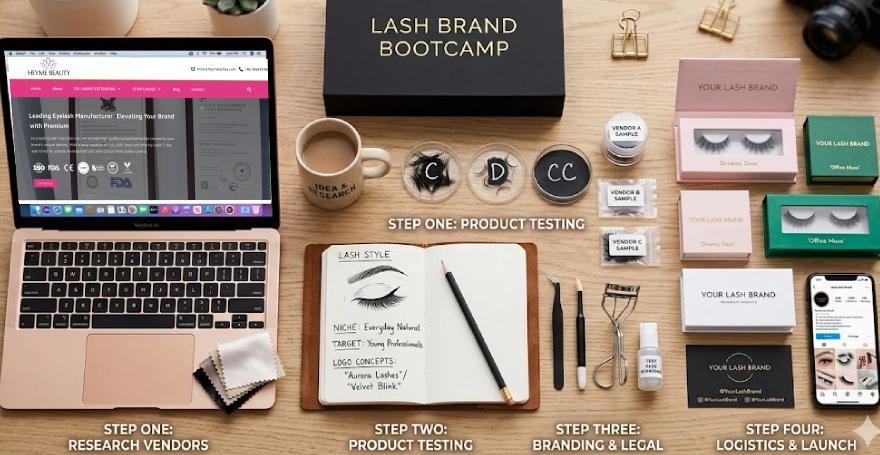
Step One: Figure Out What You’re Actually Selling
Sounds obvious, right?
You’d be surprised how many people come to me saying “I want to start a lash brand” and when I ask what kind of lashes, they look at me like I just asked a trick question.
There’s no such thing as just “lashes.”
From where I sit in the factory, here’s what you need to decide before you do anything else.
Cluster lashes or strip lashes? These are completely different products with different customers, different adhesives, and different manufacturing processes. Cluster lashes are smaller, applied under or above the natural lash line, and meant to last several days. Strip lashes go on in one piece and come off the same night. They’re not interchangeable.
Magnetic or adhesive? Magnetic lashes sound great in theory — no glue, reusable. In reality, they’re a smaller market and the manufacturing tolerances are brutal. The magnets have to be perfectly placed or the whole product is trash. We make both. But I’ll tell you straight: adhesive lashes sell better.
Material matters more than most brands realize. Synthetic fibers are the workhorse — affordable, consistent, no ethical questions. Silk is softer, more expensive, and feels more luxurious. Mink? Real mink is getting banned in more places every year. Many brands say “mink” when they really mean a synthetic blend. Don’t be that brand. Be clear about what you’re selling.
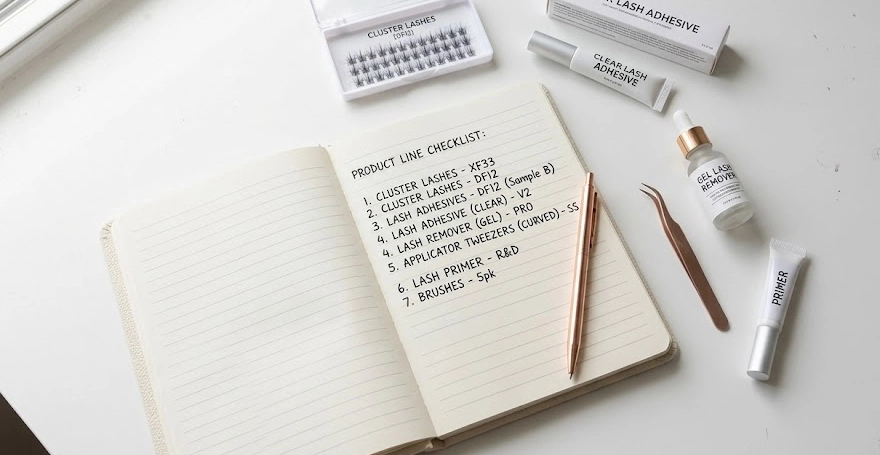
And don’t forget the system. The brands that do well long-term don’t just sell lashes. They sell lashes plus adhesive plus remover plus applicator tools. Why? Because that’s how you build reorder cycles. Your customer buys the kit, runs out of glue, comes back to you. Not to some random Amazon listing.
So before you design a single box, write down exactly what’s in your product line. Be specific. Be realistic. Because that list is what you’re going to take to a manufacturer.
Step Two: Understand What This Is Actually Going to Cost You
Nobody likes talking about money. But avoiding the conversation is how people end up three months in with nothing to show and a credit card bill that makes them nauseous.
Let me give you real numbers based on what I see every day.
Minimum startup capital. For a small but legitimate lash line — let’s say three styles of cluster lashes, one adhesive, one remover — you’re looking at a range. At the low end, you can get started with a few thousand dollars if you’re smart about it and keep your SKUs tight. At the higher end for more styles and fancier packaging, more.
Here’s what most people forget: the upfront cost isn’t the only cost.
MOQ is not the whole story. Minimum order quantities vary wildly between factories. Some will do five hundred units of a single SKU. Some won’t talk to you for less than ten thousand. We’re somewhere in the middle because we work with both startups and established brands.
But MOQ is just the entry ticket. You also need to think about:
Tooling and molds. If you want custom packaging — a uniquely shaped tray, a specific bottle for your adhesive — there’s almost always an upfront mold cost. This is a one-time expense but it can be significant. The trade-off is that your product looks like nobody else’s.
Testing and certification. This is not optional. Good manufacturers do internal testing. But for peace of mind and regulatory compliance, third-party testing matters. Different markets have different requirements. The US, Europe, and Asia all have their own standards for cosmetics. Know where you’re selling before you manufacture.
Shipping and storage. The product exists. Now you have to get it from our dock to your customer’s hands. Freight costs have been unpredictable. Warehousing costs add up. This is the part of the budget that first-time brand owners almost always underestimate.
I’m not telling you this to scare you. I’m telling you this because the brands that survive are the ones who go in with their eyes open.
Step Three: Find a Factory You Can Actually Trust
This is where everything falls apart for most people.
You go on Alibaba. You see a thousand suppliers. All of them have beautiful photos. All of them say they’re “manufacturers.” Half of them are trading companies with a good sales pitch and no factory of their own.
How do you tell the difference? Let me help you from the inside.

Ask specific technical questions. A real manufacturer can answer questions about material sourcing, curing times for adhesives, viscosity ranges for removers. A trader will Google your question or give you a vague answer. Test them.
Ask for batch consistency records. Any factory can send you one perfect sample. What happens when you order ten thousand units? Ask to see their quality control process. Ask how they ensure batch number fifty looks exactly like batch number one.
Ask about lead times and what affects them. A good manufacturer will tell you: “Three to four weeks for production, plus shipping. But if you want custom packaging, add two weeks for the mold.” A bad one will say “no problem” to everything and figure it out later.
Ask for references from other brands. Not names necessarily — NDAs exist for a reason. But ask if they’ve worked with brands in your market before. Ask about their experience with similar order sizes.
Here’s what a good factory looks like from the inside:
We answer your emails within a day. Not instantly — we’re actually making products, not sitting by a phone. But we don’t leave you hanging for a week.
We tell you when something isn’t possible instead of promising and failing. I’d rather lose a sale than ruin a relationship.
We have documentation. Test reports. Ingredient specifications. Batch records. Not because we love paperwork but because when something goes wrong — and sometimes things go wrong — we need to know what happened.
We care about your success because your success means you order again.
That last one is the real secret. A factory that sees you as a long-term partner is worth ten factories that see you as a one-time invoice.
Step Four: Nail Your Formulation and Packaging
Let’s get into the actual product.
Lash formulation is not one-size-fits-all.
Different markets want different things. US customers tend to prefer a more natural, fluffy look. The European market often goes for more volume, more drama. Asian beauty standards lean toward curl and length with a very specific shape.
A good manufacturer has multiple formulas. We can adjust:
- Curl retention. How long does the lash hold its shape after being packaged for three months?
- Softness and flexibility. Stiff lashes feel cheap. Too soft and they don’t hold curl.
- Band thickness. Thinner bands are harder to manufacture but feel better on the eye.
- Gloss or matte finish. Yes, this matters to some customers.
Adhesive is where brands mess up most often.
The adhesive is the most complained-about product in any lash line. Why? Because it’s chemistry, and chemistry is unforgiving.
Low-VOC, formaldehyde-free, latex-free — these aren’t marketing buzzwords. They’re safety requirements. We’ve tested adhesives that claimed to be clean but weren’t. We’ve seen brands get burned by suppliers who swapped ingredients to save money.
Here’s what we do: every batch of adhesive gets tested. We document everything. And we match the adhesive to your specific lashes — different materials bond differently.
The remover is not an afterthought.
I’ve written separately about removers, so I won’t repeat everything here. But I’ll say this: a brand that sells lashes and adhesive without a matching remover is leaving money on the table and setting customers up for frustration.
Your remover should be formulated to work specifically with your adhesive. Not a generic product that kind of works. A remover that dissolves your bond cleanly, in under a minute, without irritating the eye.
Packaging choices signal your brand position.
A $5 lash from a drugstore comes in different packaging than a $25 lash from a boutique brand. That’s obvious. But here’s what’s less obvious: packaging affects your manufacturing cost, your shipping cost, and your customer’s unboxing experience.
You can go simple — a cardboard sleeve, a plastic tray, a clear outer bag. Cost-effective, functional, nothing fancy.
You can go mid-range — magnetic closure boxes, custom tray inserts, foil stamping.
You can go luxury — heavy stock, ribbon pulls, custom everything.
We do all of them. The question is: what fits your brand and your price point?
One piece of advice: don’t over-invest in packaging on your first order. You can always upgrade later. But if you blow your budget on boxes and run out of money for product development, you’ve got nothing to put in those beautiful boxes.
Step Five: Avoid the Five Mistakes That Kill Lash Brands
I’ve watched brands come and go. The ones that disappear almost always make at least one of these mistakes.
Mistake one: copying someone else’s formula.
“I want the same lashes as Brand X.”
I hear this constantly. Here’s the problem: even if we could replicate exactly what another factory makes — and that’s a big if — you’d still be playing catch-up. You’d have no differentiation. No reason for a customer to switch to you except price. And competing on price is a race to the bottom.
Build your own product. Work with us to create something that reflects your vision, not someone else’s success.
Mistake two: choosing suppliers based only on price.
The cheapest quote is almost never the best value.
Why? Because the factory quoting the lowest price is cutting corners somewhere. Maybe they’re using lower-grade materials. Maybe they’re skipping quality checks. Maybe they’re a trader who will disappear after they collect your payment.
We’re not the cheapest. We’re also not the most expensive. We’re priced fairly for what we deliver: consistent quality, reliable communication, and products that won’t embarrass you.
Mistake three: ordering too much too soon.
I love big orders. They pay my bills. But I’ll tell you the same thing I tell my own family: don’t bet everything on your first run.
Start with a smaller order. Test the market. Get feedback. Make adjustments. Then order more.
The brands that succeed are the ones who treat their first order as a learning experience, not a make-or-break gamble.
Mistake four: skipping testing.
You tested one sample. Great. Now test the full batch.
We do internal testing on every batch. But we also encourage our brand partners to do their own independent testing, especially for their first few orders. It builds confidence. It catches issues before they become customer complaints.
Mistake five: treating the factory like an enemy.
This one breaks my heart.
Some brands come in suspicious, demanding, adversarial. They think we’re trying to rip them off. They hold back information. They make the relationship combative.
The brands that succeed long-term? They treat us like partners. They share their goals. They tell us when something isn’t working. They celebrate wins together.
We want you to succeed. Your success means you order again. You tell other brands about us. We grow together.
Be the partner, not the adversary.
How We Actually Work With Brands
Let me walk you through what it looks like to work with us.
Step one: you tell us what you want.
Not in a perfect technical spec — that’s our job. Just tell us your vision. Price point. Target customer. Volume expectations. Styles you’re considering.
Step two: we recommend formulations.
We have a library of existing formulas we can show you. Lash styles we’ve developed. Adhesive options. Remover variations.
If you want something custom, we talk about what’s possible and what it costs.
Step three: sampling.
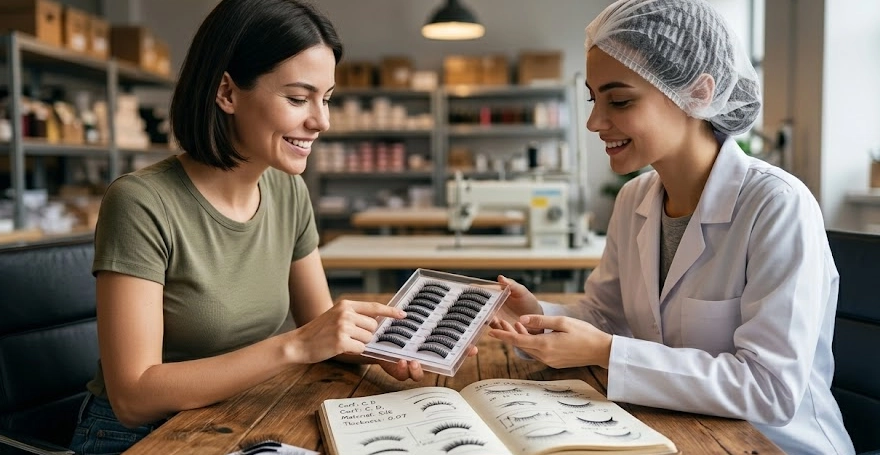
We make samples. You test them. On yourself. On friends. On anyone with honest opinions.
You come back with feedback. We adjust. Repeat until you’re happy.
Step four: packaging and branding.
You handle the creative — logo, box design, insert cards. We advise on what works from a manufacturing standpoint. We source materials or you source your own. Either way.
Step five: production.
We manufacture. We quality check. We pack. We ship.
Step six: you sell. We support.
You’re live. Customers are buying. Questions come up. Issues arise sometimes. We’re here. You’re not alone after the invoice is paid.
Conclusion
Starting a lash brand is possible.
I’ve seen it happen. People with no industry experience, no connections, just a good idea and the willingness to learn. They found the right manufacturing partner. They built something real. They’re still in business years later.
But it’s also hard.
The market is crowded. Customers have options. Margins get squeezed. Supply chains get messy.
The brands that make it are the ones who treat this like a real business, not a side project. Who invest in quality. Who build relationships with customers and suppliers alike.
If that sounds like you, we should talk.
Bring your ideas. Bring your questions. Bring your budget and your timeline.
We’ll bring the manufacturing expertise, the quality control, and the honest advice you won’t get from a trading company on Alibaba.
Ready to start your own lash brand? Contact us to discuss formulations, minimum order quantities, and sample requests. We manufacture for brands worldwide and we’re happy to help you build something that lasts.