

Let me tell you something most beauty brands don’t figure out until they’ve already lost money.
The cluster lash market is exploding. Everyone wants in. And the first thing new brands do? They source a cheap adhesive, throw together some packaging, and call it a day. The remover is an afterthought. Something they grab from the same supplier because it’s convenient.
Big mistake.
I’ve been on the manufacturing side of this industry for years. I’ve watched brands succeed. I’ve watched brands fail. And the ones that fail almost always underestimate how important the remover is to their customer’s experience.
Here’s the reality check.
Your customer isn’t going to remember the adhesive that worked perfectly. They expect that. What they will remember is the morning they spent fifteen minutes trying to get clusters off their lashes, rubbing oil into their eyes, getting frustrated, and eventually pulling hard enough that their natural lashes came with it.
That’s not a bad day. That’s a lost customer.
So if you’re a brand owner, a distributor, or running a beauty salon that applies clusters for clients, you need to understand something: the remover isn’t an accessory. It’s half the equation. Maybe more.
Why Most Cluster Lash Removers on the Market Are Garbage
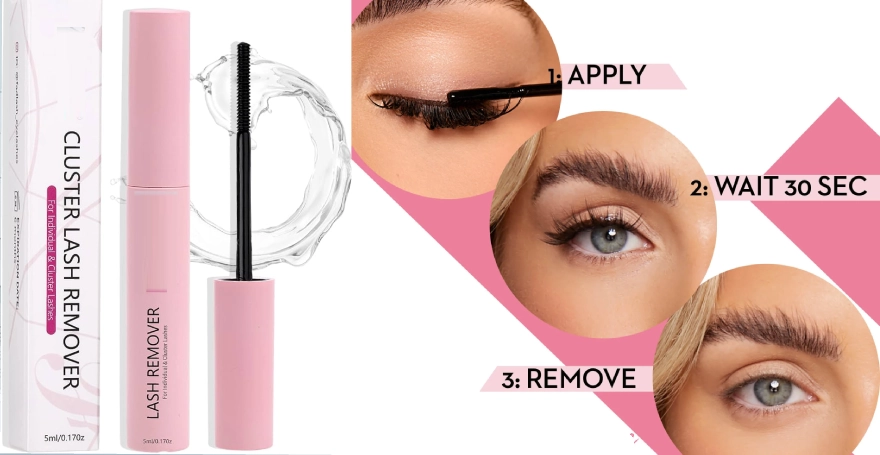
I’m not trying to trash my competitors for no reason. But let’s be honest about what’s out there.
Walk into any beauty supply store or scroll through Alibaba. You’ll find removers priced at two dollars a bottle. Sometimes less. The ingredient lists are short, which people think is good. It’s not. Those short lists usually mean one thing: the manufacturer cut every corner possible.
Here’s what cheap removers typically contain.
Acetone or something very close to it. It dissolves adhesive fast. It also dries out natural lashes, irritates the eye area, and if it gets inside the eye — which it will, because application isn’t perfect — it stings like crazy. Your customer’s first experience with your brand shouldn’t involve tears of pain.
Or they use industrial solvents that technically work but leave a residue. The clusters come off, sure. But now there’s a film on the natural lashes that makes the next application fail. The adhesive won’t bond properly. The customer thinks your product is inconsistent. Really, the remover ruined everything.
And then there’s the pH problem.
Most cheap removers don’t bother balancing pH. They’re too alkaline or too acidic. Either way, they’re irritating the skin around the eyes. Not enough to cause a lawsuit. Enough that customers notice over time. Redness. Dryness. A general feeling that something isn’t right.
You don’t want your brand associated with that feeling.
What We Do Differently as a Manufacturer
Look, I run a factory. My job isn’t to sell you on fancy marketing stories. My job is to make products that work so you can build a brand that lasts.
When a brand comes to us for a cluster lash remover, here’s what we actually talk about.
The active ingredient matters more than anything else.
We don’t use acetone. Full stop. There are better options that dissolve cyanoacrylate adhesives without attacking natural lashes or skin. The right solvent system breaks the bond in thirty to sixty seconds. Not instantly — that would require something too harsh. Not after five minutes — that’s useless for customers. The sweet spot is right in the middle.
We’ve tested dozens of formulations. The difference between a good active blend and a bad one is night and day. And it’s not just about dissolution speed. It’s about how clean the release is. Does the cluster slide off in one piece, or does it leave chunks of adhesive stuck to the natural lash?
pH isn’t optional.
The skin around the eye has a natural pH around seven. Tears are similar. We formulate our removers between six and seven point five. That range is comfortable. It doesn’t sting. It doesn’t cause delayed irritation.
I’ve had brand owners ask me why pH matters for a product that’s only on the skin for a minute. Here’s why: because customers don’t always follow instructions. They leave the remover on longer. They get some in their eye. A balanced formula handles those mistakes gracefully. A cheap one punishes them.
We think about the whole system.
Here’s something most brands don’t consider until it’s too late.
Your adhesive and your remover need to work together. Not all cyanoacrylates respond the same way to the same solvent. We’ve had brands come to us after sourcing adhesive from one factory and remover from another. Surprise — they weren’t compatible. Clusters wouldn’t come off cleanly. Customers were furious.
We manufacture both. So when we formulate a remover, we know exactly what adhesive it needs to work with. And if you’re bringing your own adhesive formula? We can match it. That’s the advantage of working with a real manufacturer instead of a trader who’s just repackaging whatever they found cheapest.
The Technical Stuff You Actually Need to Know
I’ll keep this simple because you don’t need a chemistry degree to run a beauty brand. But you do need to know enough to ask the right questions.
Dissolution mechanism.
Cyanoacrylate adhesives polymerize when they hit moisture. That’s why they bond so well to natural lashes — there’s always some humidity present. A good remover depolymerizes that bond. It reverses the chemical reaction. The glue basically turns back into a liquid.
Bad removers don’t do this cleanly. They swell the adhesive instead of dissolving it. That’s why you get that sticky, gummy residue that takes forever to wipe off. The cluster comes off, but the mess stays.
Viscosity matters for application.
Too thin, and the remover runs everywhere. Down the cheek, into the eye, onto the pillow if someone lies down too soon. Your customers will hate this.
Too thick, and it won’t penetrate to the base of the cluster where the glue actually is. They’ll end up using twice as much product, which means they run out faster and blame your brand for being expensive.
The sweet spot is a low-viscosity gel or a thin liquid with a precise applicator. We spend a lot of time getting this right because application experience is customer experience.
Preservation and stability.
Water-based removers need preservatives. Oil-based removers don’t, but they also don’t work as well on cyanoacrylates. We use a water-based system with a gentle, globally compliant preservative package.
Stability testing is non-negotiable. Your remover needs to survive warehouse temperatures, shipping across the country, and sitting on a bathroom shelf for six months. We test for all of it.
What Brand Owners Should Ask Any Remover Supplier
Before you sign anything, ask these questions. I’m telling you this because I want you to be an educated buyer. The suppliers who can’t answer won’t like me. The ones who can? Those are the ones worth talking to.
“What’s your pH range and how do you control it?”
If they don’t know, walk away.
“Have you done skin irritation or eye safety testing?”
Good manufacturers have. We have third-party reports we can share under NDA.
“What’s your lead time and MOQ for custom formulations?”
This tells you if they’re a real factory or a middleman. Real factories have minimums because they’re actually mixing batches. Middlemen will say yes to anything then disappear when there’s a problem.
“Can you adjust the formula for my specific adhesive?”
This is the big one. If they say no, they’re selling you an off-the-shelf product that might work fine or might not. If they say yes and actually understand the chemistry, you’ve found someone who knows what they’re doing.
“What packaging options do you have?”
The bottle and applicator matter. Brush applicators are best for precision. Droppers are fine but messy. Wide-mouth bottles are a disaster waiting to happen. A good manufacturer will have opinions about this and samples to show you.
Common Mistakes We See Brands Make
I’m not saying this to embarrass anyone. I’ve just watched the same patterns repeat themselves over and over.
Mistake one: treating the remover like an afterthought.
Brands spend months perfecting their lash trays and adhesive formula. Then they grab whatever remover is cheapest from the same supplier. The remover is bad. Customers complain. The brand blames the supplier. But the real problem was priorities.
The remover is the last touchpoint in the customer’s experience with your product. It’s literally the final interaction before they decide whether to buy from you again. Why would you treat that as an afterthought?
Mistake two: ignoring the salon market.
Beauty salons that apply cluster lashes for clients have different needs than individual consumers. They need removers that work fast — clients don’t want to wait five minutes with their eyes closed. They need bulk packaging, not retail bottles. They need consistency across batches because they’re using it professionally.
If you’re not offering a salon-friendly option, you’re leaving money on the table.
Mistake three: not testing the full system.
We see this constantly. A brand tests their adhesive. It works great. They test their remover separately. Also fine. But they never test them together on actual human lashes under real conditions.
Then the first batch goes out, customers start using the products together, and suddenly there’s a problem. The remover doesn’t work on that specific adhesive. Or it works too slowly. Or it leaves residue that makes the next application fail.
Test the system. Not just the components.
What We Offer as Your Manufacturing Partner
Let me be direct about what we can do for you.
Custom formulation.
You tell us your target price point, your performance requirements, and your adhesive formula if you have one. We develop a remover that hits all of them.
Private label and OEM.
Your brand, your packaging, your specifications. We handle production, filling, and quality control.
Bulk for salons and distributors.
Not every customer wants retail-ready bottles. We supply larger formats for professional use.
Stability and safety testing.
We don’t guess. We test.
Supply chain reliability.
I run a real factory. When we commit to a lead time, we meet it. When we say we can scale production, we mean it.
Let’s Talk About What You Actually Need
Every brand is different. Some of you are just starting out and need low minimums to test the market. Some of you are established and need hundred-thousand-unit runs with custom packaging. Some of you run salon chains and want bulk concentrate you can dilute yourself.
We do all of it.
The best way to figure out if we’re a fit is to talk. Send me your requirements — target price, expected volume, any specific formulation needs. I’ll tell you what’s possible and what isn’t. No hard sell. Just an honest conversation from someone who’s been making this stuff for years.
And if you want samples to test before committing to anything? That’s standard. We’ll send them.
Because here’s the truth.
The cluster lash market isn’t going anywhere. But the brands that win will be the ones who get the fundamentals right. The adhesive matters. The lashes themselves matter. But the remover? That’s what keeps customers coming back.
Or drives them away.
Your choice.