

A full set of extensions can look effortless. What isn’t effortless is managing the chemistry behind the adhesive. Most reactions don’t come from the lashes themselves—they come from the glue, specifically the curing process and the vapors it releases.
That’s why a proper patch test isn’t a formality. It’s a filter. It tells you whether to proceed, modify, or stop.
This guide focuses on how patch testing is actually done in working salons, what the results mean, and where many artists make avoidable mistakes.
The Short Answer
To patch test eyelash glue, apply 3–5 short extensions at the outer corner of each eye using your working adhesive, or place a small amount of glue behind the ear or on the inner elbow. Leave it undisturbed and monitor the area for 24–48 hours. If there is no itching, swelling, redness, or discomfort, the client is unlikely to react during a full set. If symptoms appear, do not proceed.
That’s the basic version. The rest of this article explains why each step matters.
Why This Step Exists in the First Place
Most lash adhesives are built on cyanoacrylate, a fast-curing compound that polymerizes when exposed to moisture. That speed is what gives you retention. It’s also what produces fumes during curing.
Those fumes, along with additives like carbon black (used for color), are the main triggers for sensitivity. Not every client reacts, but when they do, it rarely improves mid-appointment. It usually escalates.
There are two different reactions artists often confuse:
- Irritation: mild redness, slight stinging, often linked to fumes or improper isolation. It may pass.
- Allergic response: swelling, itching, watery eyes, sometimes delayed by a day. This is the immune system responding to the adhesive.
A patch test helps you distinguish between a client who might tolerate a full set with proper technique and one who should not be exposed at all.
There’s also a non-technical reason: accountability. If something goes wrong and no patch test was performed, the responsibility sits entirely with the artist. Good documentation changes that.
Two Ways to Run the Test
There are two commonly used approaches. Both are valid, but they answer slightly different questions.
Method A: A Small Set on the Outer Corner
This is the method most experienced artists rely on.
A few extensions—usually three to five—are placed on each eye, positioned at the outer corner where irritation is easier to manage if it occurs. The same adhesive, humidity, and working speed are used as in a real appointment.
This method exposes the client not just to the glue, but to the fumes during curing, which is often the real issue.
It takes more time than a simple skin test, but it reflects reality more accurately.
Method B: A Skin Dab
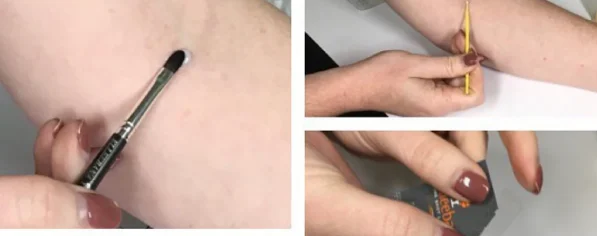
A small amount of adhesive is applied to the skin behind the ear or inside the elbow.
This avoids the eye area completely and is sometimes used for clients who are anxious, extremely sensitive, or new to cosmetic treatments.
However, it has a limitation: it does not replicate the conditions of lash application. The eye area is more delicate, and the exposure to fumes is different.
So while a negative result here is useful, it’s not as conclusive as Method A.
How Professionals Actually Run It
A proper patch test isn’t rushed. It follows a sequence that removes variables.
Start with a conversation.
Ask about previous reactions—not just to lashes, but to adhesives, tapes, or even nail products. Cyanoacrylate is used in more places than clients realize. Recent eye procedures, infections, or medications also matter.
Prepare the area.
For the lash method, cleanse the lashes as you would before a full set. For the skin method, clean the area with a gentle, oil-free solution. Any residue can affect how the adhesive cures.
Use a minimal amount of glue.
This is not a mini appointment. You’re testing response, not retention.
Apply and step away.
Once the test is done, don’t add more “just to be sure.” Overexposure defeats the purpose.
Set expectations clearly.
Clients need to know what to look for and when. A reaction may not appear immediately. Many allergic responses show up the next day.
Write it down.
Record the date, adhesive used, method, and result. If you run a salon, this isn’t optional—it’s part of your protection.
Reading the Result Without Guesswork
A patch test only helps if you interpret it correctly.
A negative result is straightforward: no visible change, no discomfort, no delayed symptoms. In this case, you can proceed with a full set, while still working carefully.
A positive result can vary in intensity. It may start as itching, progress to redness, or develop into swelling around the eyes. In stronger cases, small bumps or rashes appear.
If any of these signs show up, the decision is simple: do not proceed with standard adhesive.
Trying to “work around” a reaction—less glue, faster speed, different mapping—does not solve the underlying issue.
The correct response is to stop and advise the client appropriately. Cold compresses can help with mild symptoms, but anything persistent should be checked by a medical professional.
A Quick Look at Adhesive Types
Not all lash glues behave the same way. Some are designed for speed and retention. Others are adjusted to reduce sensitivity.
| Feature | Standard Professional Adhesive | Sensitive Formula |
|---|---|---|
| Base compound | Ethyl Cyanoacrylate | Ethoxyethyl Cyanoacrylate |
| Curing speed | 0.5 – 2 seconds | 3 – 5 seconds |
| Fume level | Noticeable | Reduced |
| Retention | 6 – 8 weeks | 2 – 4 weeks |
Sensitive adhesives are often marketed as “safer,” but that needs context. They produce fewer fumes and cure more slowly, which can reduce irritation. However, they are not a guarantee against allergic reactions. If a client is truly allergic to cyanoacrylate, changing the variant does not remove the risk.
Where Patch Tests Go Wrong
Many issues come from shortcuts.
Some artists skip the test entirely, especially with returning clients. That works—until it doesn’t. Sensitivity can develop over time, even if previous sets were fine.
Others perform the test too close to the appointment. If the full set is scheduled the next morning, a delayed reaction won’t be caught in time.
There’s also a tendency to treat a negative skin test as final proof. It isn’t. The eye area behaves differently, and fumes matter.
Another mistake is using a different adhesive for the test than for the actual set. This defeats the purpose. The test should reflect real working conditions as closely as possible.
What Clients Should Understand
From the client’s side, a patch test may feel unnecessary—especially if they’ve worn extensions before.
But reactions are not always immediate. Some develop after repeated exposure. Others appear when a new adhesive is used, even if the previous one caused no issues.
A proper test gives the client a clear answer before committing time, money, and potential discomfort.
It also sets the tone. A technician who insists on testing is not being cautious for no reason—they are managing risk.
Timing Matters More Than People Think
The safest window for a patch test is 48 hours before the appointment.
That allows enough time for delayed reactions to appear. Anything shorter increases the chance of missing a response.
In busy salons, this requires planning. It means scheduling a short visit before the main appointment. Some clients resist this at first, but most understand once the reasoning is explained.
A Note on “Curing” Allergies
A patch test does not build tolerance. It does not “train” the body to accept the adhesive.
If a client is already allergic, repeated exposure usually makes the reaction worse, not better.
There’s no workaround for that. The only responsible option is to avoid standard lash adhesives altogether.
Conclusion
Patch testing adds a step. It takes time, requires explanation, and sometimes leads to turning a client away.
But that’s exactly why it matters.
In practice, this is one of the clearest lines between rushed work and professional work. Not because it’s complicated, but because it requires discipline.
Lash extensions are built on precision—placement, isolation, timing. The adhesive deserves the same level of respect.