

There is a specific, sinking feeling that only a lash lover knows. It happens the moment your lash artist hands you the mirror after a removal. Suddenly, the reflection looks foreign. Without the dark, sweeping canopy of your extensions, your eyes feel exposed, and your natural lashes—once ignored—now seem fragile, sparse, and heartbreakingly short.
In the industry, we call this the “Extension Hangover.” But before you spiral into a Google-fueled panic about permanent damage, take a breath. As a vertically integrated manufacturer that has spent two decades perfecting the chemistry and physics of lash fibers, we are here to tell you: Your lashes aren’t gone; they are simply exhausted. This guide is your roadmap to a full-volume recovery, designed by engineering experts who understand the science behind the hair follicle.
The Biological Clock: How Long Must You Wait?
Patience is a difficult pill to swallow when you feel “lash-bald,” but your body operates on a rhythmic internal clock. To manage your expectations, you must understand the Lash Growth Cycle (Anagen, Catagen, and Telogen). Every hair on your lid is at a different stage of its life.
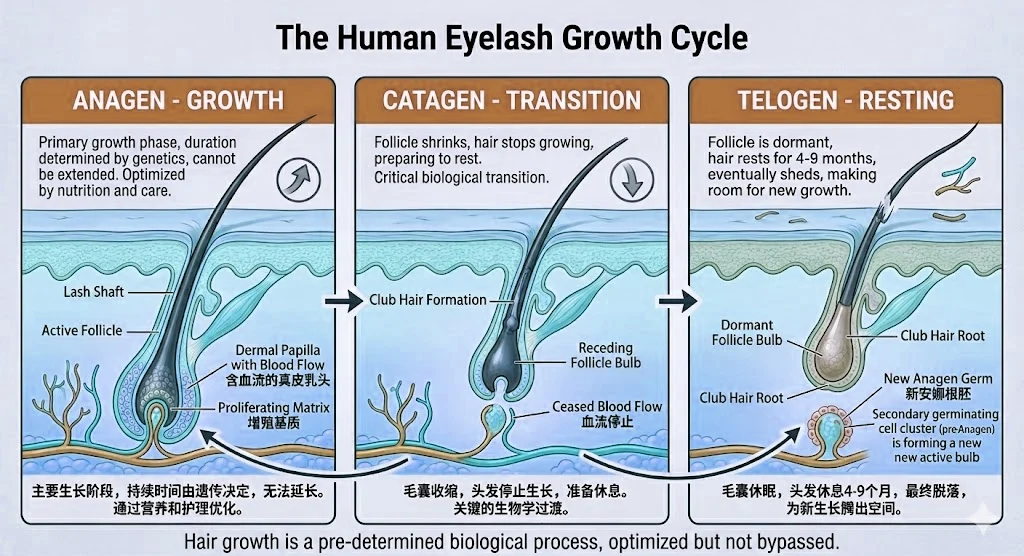
If you have experienced mild thinning, you will likely see a return to normalcy within 2 to 4 weeks. However, if your lashes were caught in the crossfire of a rough removal or an overweight set, you are looking at a 6 to 8-week journey. This is the time it takes for a new follicle to wake up and sprout its full, tapered potential.
Decoding Your Damage: Which “Recovery Path” Are You On?
To treat your lashes, you must first diagnose the “crime scene” left behind. Not all damage requires the same intervention. We have categorized the most common recovery timelines based on industrial observations of lash fiber stress.
Table: Estimated Recovery Timeline by Damage Type
| Damage Type | Visual Signs | Recovery Strategy | Estimated Time |
| Visual Gap | No real loss; lashes just look thin compared to dark 6D extensions. | Normal hygiene + Peptide-based Lash Serum. | 2 Weeks |
| Broken Tips | Lashes have flat, blunt ends; feel prickly to the touch. | Protective coating + Avoid waterproof mascara. | 4 Weeks |
| Premature Shedding | Noticeable bald spots along the lash line (Traction Alopecia). | Intensive Serum + Follicle Stimulation. | 6-8 Weeks |
| Follicle Fatigue | Lashes are present but grow back very fine, light, or stunted. | Deep cleansing with Lint-Free Micro Swabs. | 8+ Weeks |
The Recovery Masterclass: How to Grow Lashes Back Faster
Growing your lashes back isn’t about luck; it’s about creating a high-performance environment for keratin synthesis.
1. The Chemistry of Growth (The Signal)
Don’t just reach for any “miracle oil.” Professional recovery requires Peptides and Biotin. Peptides act as the “project managers” for your follicles—they signal the skin to keep the lash in the growth phase for longer. Biotin provides the structural integrity, ensuring new “baby” lashes don’t snap prematurely.
2. The “Clean Canvas” Philosophy (The Environment)
This is where most people fail. In an attempt to “save” their remaining lashes, they stop washing their eyes. This is a mistake. Sebum, dead skin, and adhesive debris create a “plug” that stifles new growth.
As an OEM manufacturer, we recommend a clinical approach. This is the moment to introduce lint-free micro swabs into your routine. Unlike cotton pads that leave behind jagged fibers that irritate the lash line, these precision tools allow you to clear debris from the “root zone” without tugging.
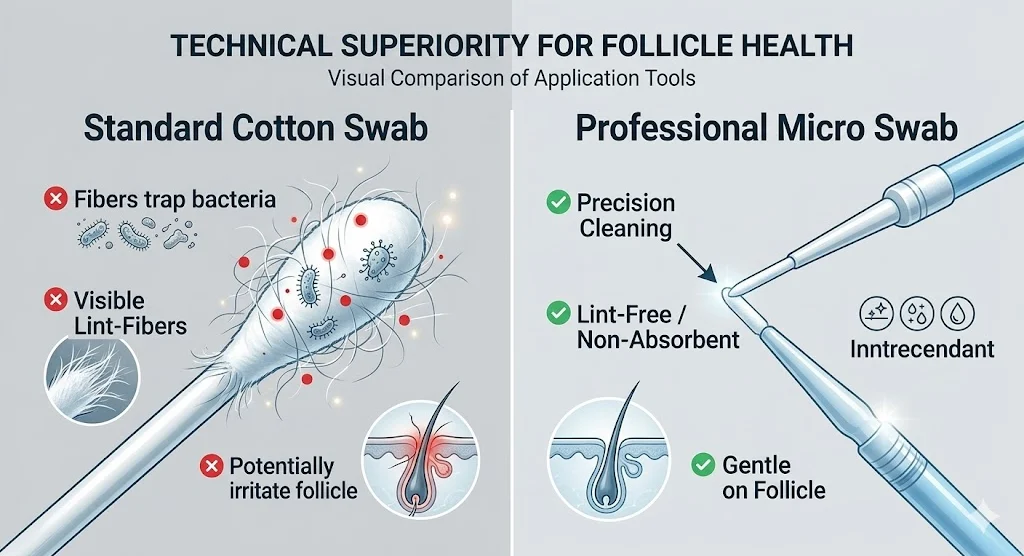
If you have experienced mild thinning, you will likely see a return to normalcy within 2 to 4 weeks. However, if your lashes were caught in the crossfire of a rough removal or an overweight set, you are looking at a 6 to 8-week journey. This is the time it takes for a new follicle to wake up and sprout its full, tapered potential.
The Manufacturer’s Insight: Engineering a Better Future
If you are a frequent wearer of extensions, your recovery period is the perfect time to audit your “Lash Wardrobe.” Most damage is caused by a mismatch between the extension’s weight and the natural lash’s strength.
In our factory, we focus on the Physics of the Lash. We have found that the move toward Y-Lash and YY-Lash structures is a game-changer for long-term lash health. Traditional round lashes put immense vertical pressure on the follicle. However, the flat-base engineering of a Y-Lash allows the weight to be distributed horizontally.
When you do return to extensions, look for 0.05mm or 0.07mm PBT fibers. These are the “industrial-grade” gold standard—ultra-light, high-memory, and virtually weightless.
The “Transition” Look: Beauty Without the Burden
You don’t have to hide while your lashes recover. The modern beauty world offers “low-impact” alternatives that keep you polished without sabotaging your follicles.
- DIY Cluster Lashes: These are the unsung heroes of recovery. Because they are designed for short-term wear and use a flexible bond, they allow your natural hairs to breathe.
- Magnetic Lashes: These offer a zero-adhesive experience, ensuring your delicate new growth isn’t being tugged by glue every morning.
FAQ
Can I use castor oil for regrowth?
Castor oil is an excellent natural emollient for conditioning the hair you already have, preventing brittleness and breakage. However, from a molecular standpoint, it cannot “wake up” a dormant follicle or accelerate the Anagen (growth) phase. Use it for surface shine, but rely on a peptide-based serum for actual speed and density.
Will my lashes ever be the same?
Actually, they can be better. By implementing a professional recovery system and focusing on follicle hygiene during this break, many women find their lashes return thicker and more resilient than their pre-extension baseline. It’s all about resetting the “soil” (your lash line) so the “seeds” (your follicles) can thrive.
Is it safe to wear mascara while my lashes are recovering?
Yes, but with a strict caveat: Avoid waterproof formulas. Waterproof mascara requires aggressive rubbing and heavy oil-based removers to clean, which can snap fragile new growth. We recommend using a “tubing” mascara that slides off with warm water, or better yet, a clear conditioning mascara to keep them nourished.
Why do my lashes look shorter even though I didn’t pull them out?
This is often “visual recalibration.” After weeks of wearing dark PBT fibers with a specific curl (like D or CC curl), your natural lashes—which have a softer, more horizontal taper—look shorter by comparison. However, if there is actual thinning, it’s usually due to follicle suffocation from leftover adhesive residue or poor hygiene during the extension period.
When is it safe to get extensions again?
As an Original Manufacturer, we suggest waiting at least one full growth cycle (6 weeks) if you experienced significant damage. When you do return, request a “Lash Health Consultation.” Suggest that your artist use lightweight Y-Lashes or 0.05mm fans with a smaller attachment area to ensure your newly recovered lashes aren’t immediately overloaded by excessive weight.
Your Journey Back to Volume
Lash recovery is a testament to the body’s ability to heal. While the “mirror shock” of a removal is real, it’s also a fresh start. By shifting your focus from “covering up” to “cultivating,” you aren’t just waiting—you are engineering a stronger, healthier foundation for your next set.
Professional beauty is built on professional tools. From the precision of a micro swab to the lightweight engineering of a Y-Lash, the choices you make during these six weeks will define your lash health for years to come.
Ready to start your recovery? If you are a salon owner or a beauty enthusiast looking for professional-grade recovery tools, explore our factory-direct care kits and lightweight fiber options. Let’s build your lash health, together.