

If you’ve ever finished a lash set and felt like something was slightly off—even though your fans were clean and your placement was correct—you’re not alone.
It’s a subtle feeling. The lashes look good at first glance, but the balance isn’t quite there. Maybe the outer corners feel heavy. Maybe the set looks shorter than expected, even though you used longer lengths. Or the retention just isn’t as strong as it should be.
In many of these cases, the issue doesn’t come from technique.
It comes from length selection.
Understanding eyelash extension lengths at a deeper level is what separates consistent, professional work from results that feel unpredictable. Because length is not just a number—it’s a structural decision that affects how the entire set looks, feels, and performs over time.
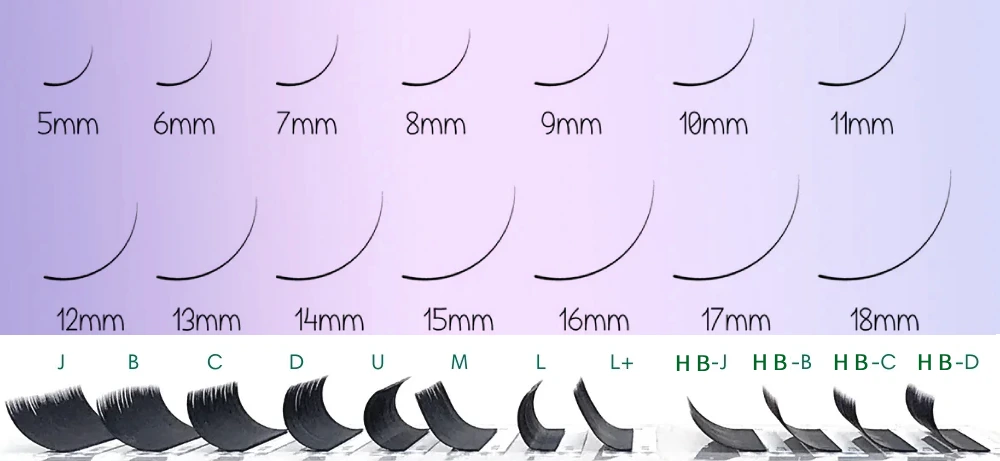
Why Lash Length Is More Complex Than It Seems
At first, lash lengths appear straightforward. They’re measured in millimeters, typically ranging from around 5mm to 20mm. You might assume that choosing between 10mm and 12mm is a small adjustment.
In practice, it rarely feels small.
That 2mm difference can change how the lash line appears from a distance, how the eye opens, and even how the extensions sit on the natural lash. What looks like a minor increase on a tray often becomes a noticeable shift on the face.
This is where many lash artists begin to feel uncertain. You follow general guidelines, but the results don’t always match your expectations. The reason is simple: length does not behave independently. It interacts with multiple variables at the same time, and ignoring those interactions leads to inconsistent outcomes.
Lash Length Categories in Real Application
Lash lengths are often grouped into short, medium, and long categories. While this classification is helpful, it only becomes meaningful when you understand how each category functions within a full lash set.
Short lengths, typically between 5mm and 8mm, are rarely used to create visible impact. Instead, they play a structural role. They are essential for inner corners and for blending transitions between longer sections. Without them, the set can appear harsh or uneven, even if the rest of the application is technically correct.
Medium lengths, usually between 9mm and 13mm, form the foundation of most lash designs. This is where the majority of the lash line is built. In commercial and everyday styles, lengths like 11mm and 12mm are especially common because they provide a balanced look that enhances the eye without overwhelming it.
Long lengths, starting around 14mm and extending upward, are used more selectively. They create emphasis and drama, but they also introduce more weight and leverage. When used without proper control, they can disrupt the balance of the set or compromise retention.
The key takeaway here is that no single category works alone. A well-designed set depends on how these lengths are combined and transitioned across the eye.
The Relationship Between Length and Natural Lash Health
One of the most important principles in lash extensions is that the extension must be supported by the natural lash. This is often simplified into the guideline of choosing extensions that are 2–3mm longer than the natural lash.
While this rule is widely taught, it is frequently misunderstood.
The purpose of this guideline is not to limit creativity—it is to maintain structural integrity. When an extension becomes too long relative to the natural lash, it creates leverage. This leverage places additional stress on the lash follicle, which can lead to twisting, premature shedding, or long-term damage.
What makes this challenging is that the effects are not always immediate. A set may look perfectly fine on the first day, only to lose its shape or retention over time. This delayed feedback can make it difficult to identify length as the root cause.
Experienced lash artists learn to recognize these patterns. Instead of focusing only on the visual result at the end of the appointment, they consider how the set will behave in the days that follow. This perspective leads to more controlled and sustainable length choices.
Why the Same Length Looks Different on Different Clients
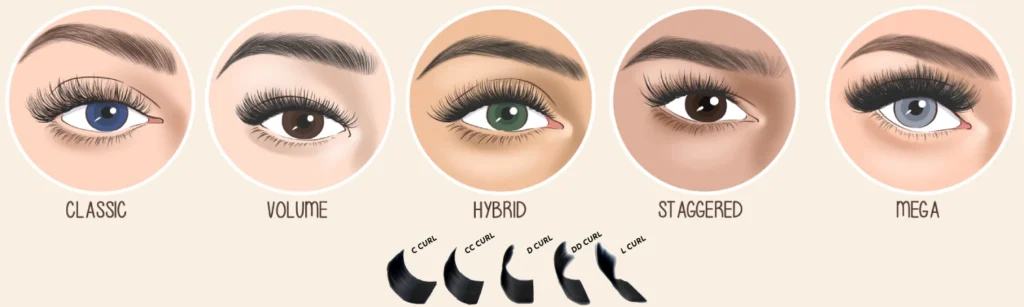
One of the most common sources of confusion is the expectation that a specific length will produce the same result on every client.
In reality, this rarely happens.
A 12mm lash on one client may appear soft and natural, while on another client it looks noticeably dramatic. This variation is influenced by several factors, including curl type, eye shape, and natural lash direction.
For example, a tighter curl such as D curl lifts upward more sharply, which can make the lash appear visually shorter compared to a C curl of the same length. Similarly, clients with hooded eyes may “lose” some of the visible length due to the way the eyelid sits, while clients with more open eye shapes may display the full extension length more prominently.
Natural lash direction also plays a role. Lashes that grow downward may require more lift or slightly longer lengths to achieve the desired visual effect, while upward-growing lashes may not need additional length to stand out.
Once you understand these variables, it becomes clear that length selection is not about choosing a number—it’s about adapting that number to the specific conditions of each client.
How Length Shapes the Overall Lash Design
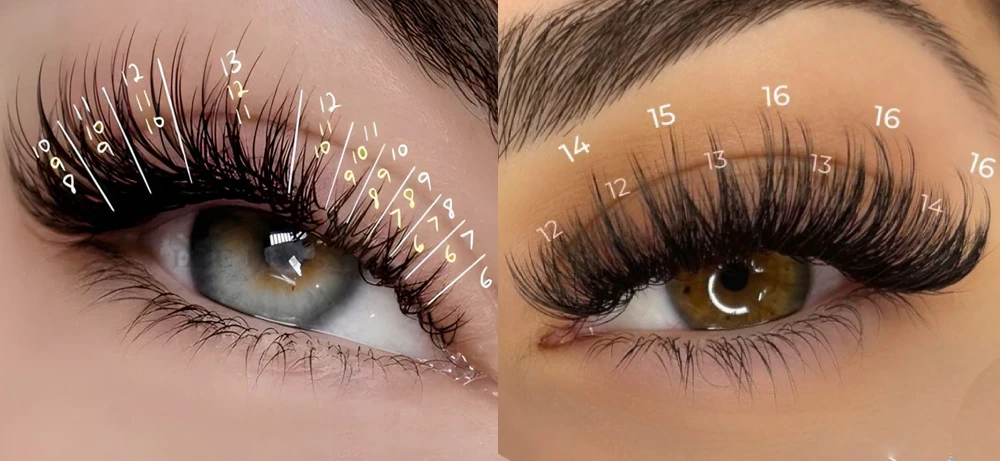
Length is one of the primary tools used to create lash styles. It determines where the eye appears lifted, opened, or elongated.
In a natural style, lengths typically increase gradually from the inner corner toward the center or outer third of the eye, then taper back down. This creates a soft, balanced appearance that follows the natural shape of the eye.
In a doll eye style, the longest lengths are placed in the center of the eye. This draws attention to the middle and creates a rounder, more open look.
In a cat eye style, lengths gradually increase toward the outer corner. When done correctly, this elongates the eye and creates a more lifted effect. However, if the outer corner becomes too long relative to the natural lash strength, the result can feel heavy or lose definition.
What’s important to understand is that these styles are not defined by curl or volume alone. They are largely created through length placement. Even small adjustments in where the longest lengths are positioned can significantly change the final look.
Where Length Mistakes Commonly Occur
Length-related issues rarely affect the entire lash set evenly. Instead, they tend to appear in specific areas.
The inner corner is one of the most frequently overlooked zones. Using lengths that are too long in this area can create crowding and discomfort, while using lengths that are too short without proper blending can make the transition feel abrupt.
The outer corner presents a different challenge. Because this area is often used to create definition or elongation, it is easy to extend lengths beyond what the natural lashes can support. This can lead to drooping or a loss of shape over time.
These issues are not always obvious during application. They become more noticeable as the set settles, which is why careful length selection from the beginning is so important.
Developing a More Reliable Approach to Length Selection
Instead of starting with a fixed length or a preset map, a more effective approach is to evaluate the client first.
This includes assessing the strength and density of the natural lashes, observing the eye shape, and understanding the client’s desired outcome. From there, you can begin to build a length plan that works within those parameters.
For clients with fine or fragile lashes, shorter lengths and lighter structures are essential. For clients with stronger lashes, there is more flexibility, but balance should still be maintained.
Lifestyle also plays a role. Clients who wear glasses, for example, may not be able to comfortably wear longer lengths. Similarly, clients looking for everyday wear may prioritize comfort and retention over maximum length.
By considering these factors together, length selection becomes more intentional and less dependent on guesswork.
The Role of Length in Advanced Styles
As techniques evolve, length is increasingly used to create texture and dimension.
In styles such as wispy or Camellia designs, different lengths are layered strategically to create variation. Longer “spikes” are combined with shorter base layers, producing a more dynamic and airy effect.
This approach requires a strong understanding of how lengths interact. Without proper control, the result can feel uneven or chaotic. When done correctly, however, it adds depth and movement that cannot be achieved with uniform lengths.
What Changes When You Master Lash Lengths
At a certain point, length selection becomes less about following charts and more about reading the eye.
You begin to anticipate how a certain length will behave before placing it. You recognize when a small adjustment will improve balance, and when a length is pushing beyond what the natural lash can support.
This shift leads to more consistent results. Not because the process becomes simpler, but because your decisions become more precise.
Instead of correcting issues after they appear, you prevent them through better planning.
FAQ
1. What is the most popular eyelash extension length?
The most commonly used eyelash extension lengths are between 10mm and 12mm. These lengths create a balanced, natural-looking result that suits most clients while maintaining comfort, good retention, and compatibility with everyday wear and different eye shapes.
2. Can eyelash extensions be too long?
Yes, extensions that are too long for the natural lash can cause twisting, drooping, and poor retention. Overly long lashes place extra stress on the natural lash, which may lead to premature shedding or long-term damage over time.
3. What eyelash extension length looks most natural?
Lengths between 9mm and 12mm typically create the most natural appearance. When combined with proper mapping and gradual transitions, these lengths enhance the eyes without looking overly dramatic, making them ideal for everyday wear and first-time lash clients.
4. How do I choose the right lash length for different eye shapes?
Choosing the right length depends on how the eye shape affects visibility and proportion. Hooded eyes may require slightly longer lengths for visibility, while smaller or rounder eyes benefit from moderate lengths to maintain balance and avoid overwhelming the eye.
5. Does lash curl affect how length appears?
Yes, curl significantly affects how length appears visually. A stronger curl like D curl lifts upward and may look shorter, while softer curls like C curl extend outward, making the same length appear longer and more noticeable on the eye.
Conclusion
Eyelash extension lengths are one of the most powerful—and most misunderstood—aspects of lash design.
While charts and guidelines provide a useful starting point, they cannot replace the understanding that comes from observing how length interacts with real clients. Every eye presents a different combination of shape, lash condition, and expectations, and successful length selection depends on adapting to those variables.
When you approach length with this level of awareness, your work becomes more consistent, your retention improves, and your designs feel more intentional.
In the end, choosing the right length is not about going longer or shorter.
It’s about knowing exactly why you’re choosing it—and what it will do once it’s placed.