

We tried to break both. One gave up faster.
Forget the ads for a minute.
If your reference for “magnetic lashes” is a clean mirror, steady hands, and ten quiet minutes—you’re testing the best-case version. That’s not where problems show up.
We stopped doing that early.
We started wearing them through full days. No touch-ups. No fixing corners. Meetings, heat, wind, long hours. Whatever happens, happens. That’s where the pattern becomes obvious.
And once you see the pattern, you can’t unsee it.
The first mistake people make is assuming these are two variations of the same thing.
They’re not.
One is a clamp.
The other is a coating.
It sounds like a small difference. It isn’t.
Where the hold actually comes from
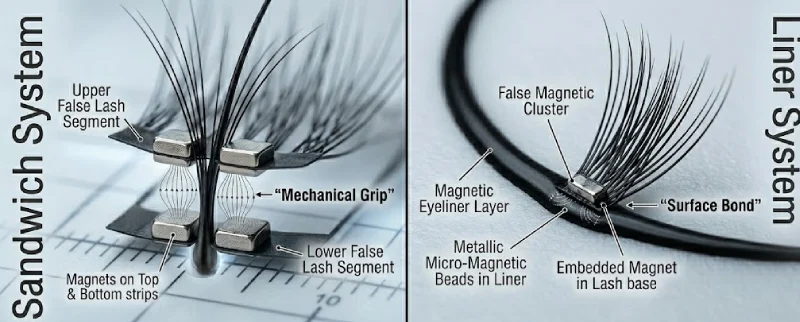
With the double-stack—what most people call the “dual magnetic”—you’re not sticking anything to your skin. You’re pinching your own lashes between two strips.
It’s a mechanical system. Old-school logic. Grip, pressure, alignment.
So everything depends on one variable most people don’t think about: your natural lashes as a structure.
If they have some body—slight thickness, a bit of stiffness—the system behaves well. You get a clean line, decent lift, and it stays where you put it.
If they’re soft or sparse, something subtle starts happening a few hours in. Not a drop. Not a visible slip. Just a quiet loss of shape.
The lash loses its snap.
It’s still attached, but the geometry is gone.
What started as a clean cat-eye slowly turns into something softer, almost sleepy. Not wrong—just not sharp anymore. Six hours is usually enough to see it.
No one calls that a failure.
But no one reorders because of it either.
The liner-based system is different from the first second.
Here, your lashes barely matter. The skin does all the work.
You draw a line, let it set, and the lash sits on top of that surface. When it’s fresh, the hold feels stronger than the sandwich type. More continuous. Less dependent on precision.
For the first few hours, it wins.
But skin isn’t a stable surface.
Oil builds. Heat shifts things. Even if you don’t notice it, the liner underneath is changing.
And then you start to feel it before you see it.
It becomes a game of wait-and-see.
You feel that tiny itch, almost like something is off. You check a mirror.
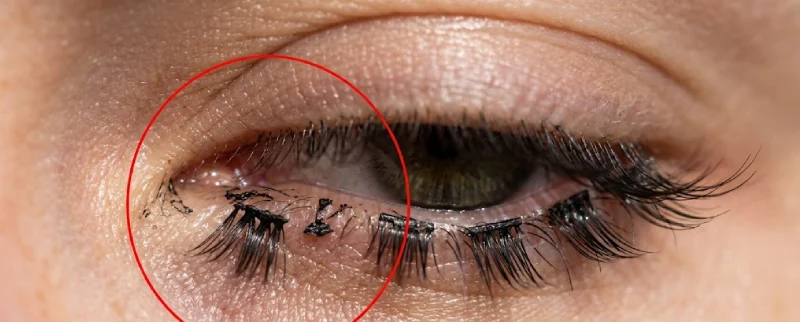
And there it is—the inner corner has surrendered.
Every single time.
Two ways things fail
After enough testing, the difference becomes very clear.
The sandwich system doesn’t collapse. It drifts.
The liner system doesn’t drift. It gives way.
Those are not the same problem.
One is slow and structural.
The other is sudden and material-driven.
Heat, oil, and the moment things turn
We ran a batch through what we call the “humidity trap.” No lab simulation. Just real conditions—heat, oil, and no air conditioning.
The liner-based lashes showed the same pattern again.
Inner corner first. Always.
Not a clean detachment. More like the lash sliding out of position because the liner underneath softened. The magnets were fine. The lash was fine.
The base layer wasn’t.
That’s when you stop blaming magnet strength.
This is not a magnet issue. It’s a polymer issue.
Sebum doesn’t just sit on the surface. It interacts with the liner base and weakens it. Once that happens, the system has nothing stable to hold onto.
The sandwich system didn’t react to oil in the same way. There’s no skin contact, so nothing is breaking down.
But that doesn’t mean it’s perfect.
On softer natural lashes, especially finer ones, we saw a different pattern: lash fatigue.
The clamp holds. But the structure underneath slowly gives.
You don’t lose the lash. You lose the lift.
That distinction matters.
Because one leads to returns.
The other leads to quiet dissatisfaction.
Wind tells you more than you expect
You don’t think about wind until you’re in it.
We tested both systems while riding—nothing extreme, just consistent airflow.
The liner version has a structural advantage here. It sits flat against the eyelid. No gaps, no entry points. Air moves over it.
In a wind tunnel—or just a breezy subway platform—it’s an aerodynamic win.
The sandwich type?
It’s a sail.
And you don’t want your lashes acting like sails.
If the placement is perfect—tight to the root—it holds. If there’s even a slight gap, airflow gets underneath. Not enough to rip it off, but enough to tilt it.
And that tilt is what people notice.
They won’t say “airflow got under the lash.”
They’ll say “this doesn’t sit right.”
Same outcome.
Water doesn’t lie
We didn’t need a special setup for this part.
Eye drops. Tears. A quick rinse.
The liner system always fails the same way.
Water enters from the inner corner, breaks down the liner, and the hold disappears from that point outward.
We opened returned units later. Same pattern across different brands.
That’s not poor quality control.
That’s how the structure behaves under moisture.
You can delay it. You can improve resistance.
You can’t eliminate it.
The sandwich system doesn’t care about water in the same way.
There’s nothing to dissolve.
If it moves, it’s because of the lash it’s attached to—not because a layer broke down underneath.
That’s why it’s the only one you can realistically call “water-resistant” without stretching the definition.
What actually drives returns
At some point, performance becomes secondary.
What matters is what happens after the third or fourth use.
With the sandwich system, the problem is not durability.
It’s usability.
Some people get it immediately. Others never do.
Alignment, pressure, angle—it takes a bit of coordination.
When they can’t get it right, they don’t blame themselves.
They blame the product.
With the liner system, usability is easy.
The problem comes later.
Residue builds up on the magnets. The liner layer changes over time. The hold becomes inconsistent.
From the user’s perspective:
“It worked before. Now it doesn’t.”
From the factory perspective:
Nothing broke.
That gap between perception and reality is where returns come from.
Cost doesn’t behave the way people expect
Most assume the lash itself is the main cost.
It isn’t.
In the sandwich system, the real variable is the magnet.
Cheap plating corrodes faster than people think. Once corrosion starts, performance drops.
Higher-grade coatings—layered, properly sealed—cost more. But they reduce long-term issues significantly.
You don’t see it in the first week.
You see it after a few months.
In the liner system, the expensive part is not the lash—it’s the liner.
Particle size, dispersion, base stability.
If the particles are too large, the liner feels gritty. If the formula is too soft, it breaks down under oil. If it’s too hard, it cracks.
You’re balancing three things:
- smooth application
- strong hold
- shelf stability
You don’t get all three easily.
We reformulated one batch three times last year.
One version had strong magnetic response—but it clumped inside the bottle within weeks. Completely unusable.
So when a supplier claims:
“strong hold, smooth application, long shelf life”
They’re either very good—or cutting something you won’t see until later.
So which one actually holds better?
If you’re asking in a controlled environment, first few hours:
The liner system feels stronger.
If you’re asking after a full day, under real conditions:
The sandwich system holds more consistently.
But that’s still not the right way to look at it.
The real choice
You’re not choosing between two products.
You’re choosing between two types of problems.
- Liner system: easier at first, but dependent on skin conditions
- Sandwich system: more stable, but dependent on user skill and lash structure
Neither is perfect.
They just fail differently.
The part most people ignore
There’s a moment—usually not on day one—where the decision reveals itself.
With liner systems, it’s that inner corner check in the mirror.
With sandwich systems, it’s that slight loss of sharpness you can’t quite explain.
Both are small.
Both are enough to change how people feel about the product.