

When people talk about mascara, they usually focus on the formula. But from a manufacturer’s point of view, that’s only half the story. The wand plays an equally important role—sometimes even more.
In product development, we don’t treat the brush as an accessory. It’s a delivery system. It determines how much formula reaches the lashes, how evenly it spreads, and whether the final look leans natural or dramatic. Two mascaras can share a similar formula, yet perform completely differently simply because of the wand design.
This is why understanding mascara wands isn’t just helpful—it changes how you evaluate the product itself. Once you know what each brush is designed to do, the results start to make a lot more sense.
How Mascara Wands Really Influence Performance
From a manufacturing standpoint, the wand isn’t just a tool—it’s half the product.
When we develop a mascara, the formula and the brush are designed together. A thick formula behaves completely differently on a dense fiber brush compared to a molded plastic comb. That’s why two mascaras with similar ingredients can give totally different results once applied.
Consumers often focus on the formula. In reality, the wand controls how that formula is delivered—how much product gets picked up, how evenly it spreads, and how well it separates lashes.
A slight change in brush density or curvature can shift the result from “natural” to “dramatic” almost instantly.
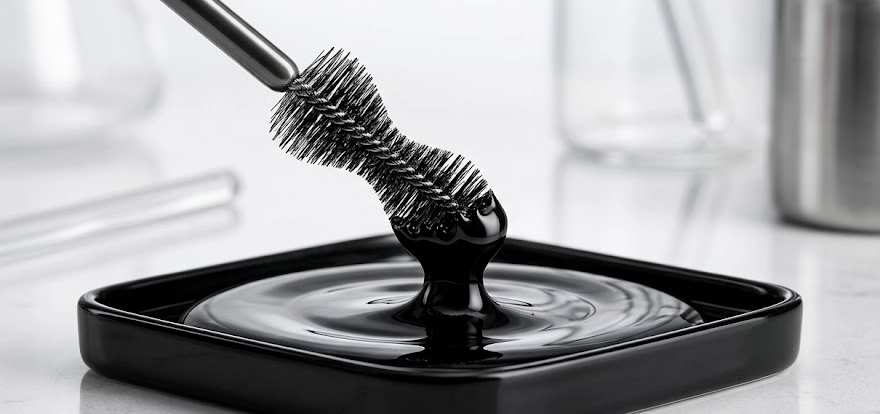
Why Different Lash Effects Start with Brush Design
When we design mascara wands in production, we usually start with one question: What problem are we solving?
Not all lashes behave the same. Some are short and sparse, others are straight and resistant to curl. So each wand type is built to guide the product differently.
- A dense brush loads more bulk onto lashes
- A slim wand reduces excess and improves control
- A curved structure physically lifts lashes during application
It’s not just aesthetics—it’s mechanical function.
Straight Wands Still Have a Place
Straight brushes are often overlooked, but they’re one of the most stable designs in production.
They’re easy to manufacture, consistent in performance, and work well with a wide range of formulas. That’s why many classic products like Maybelline Great Lash Mascara still rely on them.
From a production perspective, this type of wand is forgiving. It doesn’t require highly specialized molding or precision shaping, which helps keep costs stable while maintaining reliable results.
For the user, it delivers a clean, balanced look. Nothing dramatic—but also nothing that can go wrong easily.
Dense Brushes Are Built for Volume, But Not Without Trade-Offs
If the goal is volume, manufacturers typically increase fiber density and brush diameter.
This allows the wand to hold more formula. More product on the brush means more transfer onto the lashes. That’s how mascaras like Too Faced Better Than Sex Mascara achieve that thick, bold effect.
But here’s the part consumers don’t always see:
The more product a brush holds, the harder it becomes to control clumping. So we often have to adjust the formula—making it slightly drier or adding structuring waxes—to balance it out.
It’s always a trade-off between intensity and precision.
Curved Wands Are About Mechanics, Not Just Looks
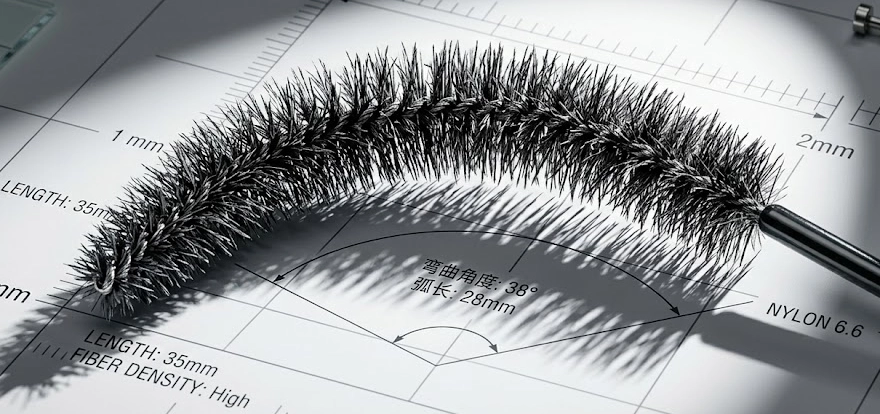
Curved brushes aren’t just a visual design choice. They physically guide lashes upward during application.
When we manufacture these wands, the curve angle matters. Even a small adjustment can change how much lift the user gets.
Products like Maybelline Lash Sensational Mascara use this structure to create a wide-eye effect without requiring a lash curler.
However, curved molds are more complex to produce and require tighter quality control. If the curve isn’t consistent, the performance becomes unpredictable.
Rubber and Plastic Wands Offer Precision at Scale
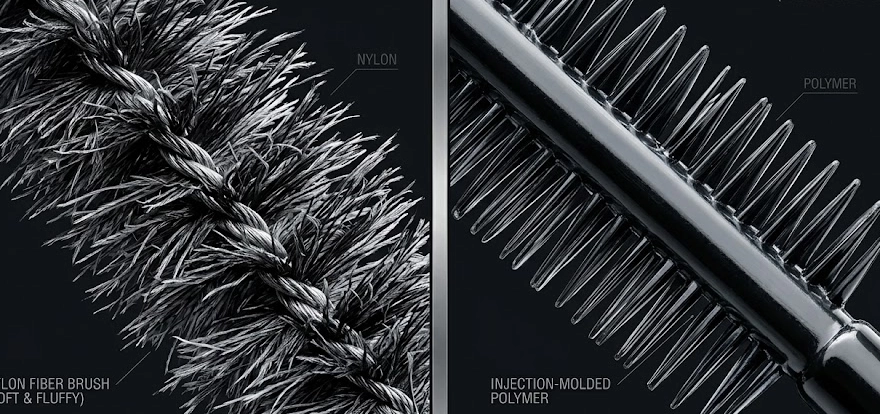
Molded plastic wands are widely used in modern mascara production because they offer consistency.
Unlike traditional fiber brushes, which can vary slightly during assembly, plastic wands are injection-molded. That means every unit is nearly identical.
This is why products like L’Oréal Telescopic Mascara deliver such precise separation.
From a manufacturing perspective, this reduces variability. From a user perspective, it means cleaner lashes with less effort.
Hourglass Shapes Are Designed to Balance Multiple Effects
The hourglass wand tries to do everything at once—volume, curl, and reach.
The wider middle deposits more product on the center lashes, while the tapered ends help coat smaller lashes near the corners.
Designing this type of wand is more complex than it looks. The fiber length has to vary across the brush, and alignment during assembly becomes critical.
That’s why products like Benefit Bad Gal Bang Mascara stand out—they get that balance right.
Tapered Wands Solve a Precision Problem
One of the most common user complaints is difficulty reaching inner corner lashes.
Tapered brushes address that directly. The narrow tip allows for controlled application in tight areas without smudging.
From a production standpoint, this requires more refined shaping and sometimes dual-material construction.
A well-known example is CoverGirl Lash Blast Mascara, which uses this approach to improve usability.
Small Details Like Ball-Tip Wands Serve Niche Needs
Ball-tip designs are less common, but they serve a specific purpose: individual lash definition.
They’re not mass-market favorites because they require more effort to use. But for detailed work, they offer unmatched control.
A product like Givenchy Phenomen’Eyes Mascara reflects this design philosophy—precision over speed.
How Manufacturers Match Formula with Wand Design
This is where real product development happens.
We don’t design the wand first and then pick a formula. Both are developed together.
For example:
- A wet formula needs a separating wand
- A dry formula pairs better with dense brushes
- Flexible wax systems require structured bristles
If these elements don’t align, the product fails—no matter how good each component is individually.
Choosing the Right Wand Isn’t Just a Consumer Decision
From a manufacturer’s perspective, selecting a wand is also about:
- Production cost
- Supply chain stability
- Compatibility with filling systems
- Packaging constraints
What looks like a simple brush is actually the result of multiple engineering and business decisions.
Common Mistakes We See in Product Development
Even experienced brands get this wrong sometimes.
- Overloading a dense brush with a wet formula
- Using a precision wand for a volume-focused product
- Ignoring user skill level
These mistakes lead to poor reviews—not because the idea is bad, but because the execution doesn’t match the design intent.
FAQ
Which mascara wand is best for volume?
Dense, fiber-packed brushes are the industry standard for high-volume results because their large surface area carries a significant amount of formula “bulk.” These bristles act like a reservoir, depositing more product onto each lash in a single swipe for an immediate thickening effect. If you want drama, look for a brush with a high bristle-to-surface-area ratio.
Are plastic wands better than traditional brushes?
Not necessarily; it depends on your specific goal for the lash line. Molded plastic wands excel at precision and individual lash separation, making them ideal for a clean, defined look with zero clumps. However, they lack the “wrapping” ability of traditional fibers, which makes them less effective for building massive, heavy-duty volume.
Why do some mascaras clump easily?
Clumping is usually a mechanical mismatch where a thick, wax-heavy formula is paired with a brush that doesn’t have enough spacing to comb through the lashes. If the wiper inside the tube isn’t calibrated to strip enough excess product, the wand enters the lash line overloaded. At Heyme Beauty, we prioritize the “wiper-to-wand” fit to ensure only the necessary amount of formula reaches your eyes.
Can one wand type suit everyone?
From a manufacturing perspective, we know there is no universal “holy grail” brush because lash biology varies wildly. Factors like lash density, natural curl, and eyelid shape determine how a brush performs on an individual level. A wand that offers a perfect “lift” for straight lashes might be redundant for someone with a natural, tight curl.
Do expensive mascaras use better wands?
Price isn’t always an indicator of the raw material cost, as most high-end and drugstore wands are made from similar PBT or silicone polymers. The real difference in luxury products is often the “design tuning”—the hours spent testing the exact bristle angle and formula viscosity synergy. You are paying for the R&D that ensures the brush and the tube’s internal wiper work in perfect harmony.
How often should mascara be replaced?
We strictly recommend a three-month replacement cycle for both hygiene and mechanical performance. Beyond the risk of bacteria buildup, the formula begins to oxidize and dry out every time the tube is opened, which changes the viscosity. Once the formula thickens past its design limit, even the best wand will start to perform poorly and cause clumping.
Conclusion
A mascara wand might look simple, but it’s one of the most engineered parts of the product.
Every curve, every bristle, every material choice affects the final result.
When users find a mascara that “just works,” it’s usually because the formula and the wand were designed as one system—not as separate pieces.