

If you’ve been in the lash industry long enough, you’ve probably had that uncomfortable moment.
A client texts you two days after her appointment:
“My eyes are swollen. Is this normal?”
And suddenly, you’re not just a lash artist — you’re navigating safety, liability, brand trust, and client care all at once.
This is exactly why understanding Cyanoacrylate Allergy in Lash Extensions: Symptoms, Causes & Prevention (2026 Guide) is no longer optional in 2026. It’s foundational knowledge for anyone serious about building a sustainable lash business.
Let me break this down in a real, practical way — not just theory, but what actually happens behind the scenes.
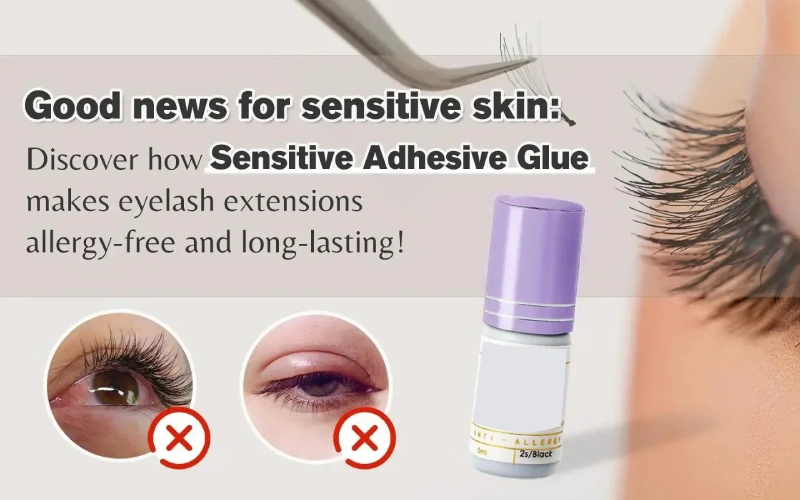
Why Cyanoacrylate Is Essential — and Why It’s Also the Risk Factor
First, we need to be honest about something:
There is no professional lash adhesive without cyanoacrylate.
It’s the backbone of modern lash retention. When exposed to moisture (even microscopic humidity in the air), cyanoacrylate undergoes rapid polymerization. In simple terms? It hardens instantly and locks the extension onto the natural lash.
That’s why we get:
- 1–2 second cure times
- 3–6 week retention
- Lightweight bonding
- Minimal product usage
Different adhesives use different forms:
- Ethyl cyanoacrylate – Fast, strong, industry standard
- Butyl cyanoacrylate – More flexibility, slightly slower curing
- Alkoxyethyl cyanoacrylate – Lower fume output for sensitive clients
At Heymebeauty, we test adhesive viscosity, curing behavior under variable humidity, and fume dispersion levels because performance without safety isn’t professional — it’s reckless.
But here’s the reality: even perfectly formulated cyanoacrylate can trigger sensitivity under repeated exposure.
That’s not a product failure. That’s biology.
Special Note: How Cyanoacrylate Allergy Relates to False Eyelash Glue (Strip Lash Adhesives)
Before we go further, I want to clarify something that often causes confusion.
Professional lash extension adhesive and false eyelash glue (the kind used for strip lashes) are not the same product — and they do not behave the same way.
Most retail strip lash glues do not rely on high concentrations of cyanoacrylate as their primary bonding ingredient. Instead, they often use latex-based formulas or lower-strength acrylic compounds designed for temporary wear (typically 8–12 hours). Because strip lash glue sits on the skin of the eyelid — rather than bonding directly to natural lashes — the exposure pattern is different.
However, allergic reactions can still occur.
With strip lash glue, reactions are usually caused by:
- Latex sensitivity (very common)
- Fragrance additives
- Preservatives
- Low-grade resins in cheaper products
Symptoms typically include:
- Redness along the lash band line
- Itching on the eyelid skin
- Mild swelling
- Peeling skin after removal
Unlike extension adhesive reactions, which are often delayed 24–48 hours due to immune sensitization, strip lash glue reactions usually appear within a few hours because the glue sits directly on the skin.
This distinction is important for brands and lash professionals. If a client reports a “lash glue allergy,” we must ask:
Was it extension adhesive — or strip lash glue?
The cause, risk profile, and prevention strategy are completely different.
At Heymebeauty, we always educate customers on this difference because informed clients make safer choices — and clear education prevents misinformation from spreading in the market.
How the Body Develops a Cyanoacrylate Allergy
Here’s where we go deeper.
Cyanoacrylate allergy is typically classified as a Type IV delayed hypersensitivity reaction. That means the immune system doesn’t react immediately. It builds memory.
The first few exposures? The body quietly registers the chemical.
Over time, immune cells (T-cells) become sensitized. Eventually, they overreact to even small amounts of exposure.
This explains why:
- A client can wear lashes for 2 years without issues
- Then suddenly experience swelling
- And each subsequent exposure becomes worse
This is also why patch tests are helpful — but not foolproof. Sensitization can occur after the patch test itself.
For lash artists, daily inhalation of adhesive fumes increases occupational risk. Chronic exposure may cause:
- Persistent rhinitis
- Airway irritation
- Dermatitis on fingers
- Sensory headaches
This isn’t talked about enough in training programs. But it should be.
What a True Reaction Looks Like (And How to Differentiate It)
Not every red eye equals allergy.
Let’s separate irritation from allergic reaction.
Irritation (Common, Mild)
- Slight redness immediately after appointment
- Mild watering
- Temporary discomfort
- Resolves within hours
Usually caused by:
- Eye pads touching waterline
- Fumes during curing
- Client slightly opening eyes
Allergic Reaction (More Serious)
- Swelling 24–48 hours later
- Intense itching
- Puffy eyelids (sometimes fully swollen shut)
- Skin flaking or blistering
- Symptoms worsening with repeated fills
This delayed onset is the biggest clue.
If symptoms intensify with each refill, it’s likely sensitization.
I always tell clients: if swelling begins, don’t “wait it out.” Early removal reduces severity.
Environmental and Technical Triggers Most Artists Overlook
Here’s where experience matters.
In my observation, many so-called “allergies” are amplified by poor environmental control.
Let’s talk about humidity.
Cyanoacrylate cures through moisture interaction. When humidity is too low:
- Glue cures slower
- More fumes are released
- Irritation risk increases
When humidity is too high:
- Glue shock cures
- Bond becomes brittle
- More micro-fracturing = more fumes
Ideal range? 45–60% humidity, 20–24°C temperature.
Ventilation is another silent factor.
Even premium adhesive will cause discomfort in a sealed room with stagnant air. Proper airflow reduces fume concentration significantly.
At Heymebeauty, we always recommend pairing adhesive selection with environmental monitoring. Product and technique must work together.
Prevention: A Professional’s Responsibility
Now let’s talk about prevention — not just basic tips, but professional-level protocol.
1. Adhesive Selection Matters
Cheap glue often contains unstable formulations or inconsistent purity. Even trace impurities increase irritation potential.
Professional brands provide:
- SDS (Safety Data Sheets)
- Ingredient transparency
- Batch consistency
- Quality testing documentation
This isn’t marketing fluff. It’s risk management.
2. Technique Is Everything
Adhesive should bond to hair — never skin.
Poor isolation causes:
- Adhesive spread
- Lash sticking
- Direct skin exposure
Micro-dosing glue (using minimal amount per extension) reduces fume release significantly.
3. Protecting the Artist
I see too many artists sacrifice their health for speed.
Protective measures include:
- Nitrile gloves
- Fume extraction systems
- Carbon air purifiers
- Regular breaks during long sets
Long-term career sustainability depends on this.
4. Client Screening
Before application, ask about:
- Asthma
- Chronic sinus issues
- Eyelid eczema
- Contact dermatitis history
Clients with active eye infections (like conjunctivitis or styes) should never receive extensions.
What To Do If a Reaction Happens
First rule: Stay calm.
Remove extensions professionally using proper remover. Never pull.
Apply cold compress to reduce inflammation.
If symptoms include:
- Vision changes
- Severe discharge
- Intense pain
Refer to a medical professional immediately.
In mild cases, symptoms usually subside within 3–7 days post-removal.
For clients who want to try again:
- Switch to a low-fume adhesive
- Increase refill interval
- Shorten application time
- Strengthen ventilation
In severe cases, discontinuation is the safest choice.
Why Brands That Prioritize Safety Win Long-Term
The lash industry is evolving.
Clients research ingredients.
They ask about certifications.
They understand risks.
Brands that hide behind marketing buzzwords won’t survive.
At Heymebeauty, our philosophy is simple:
Performance + Transparency + Education.
We don’t claim “100% hypoallergenic” — because that’s scientifically inaccurate. Instead, we focus on optimized formulations, clear documentation, and artist education.
That’s how trust is built.
And in this industry, trust equals retention — not just lash retention, but client retention.
Conclusion
Cyanoacrylate allergy is not an industry flaw. It’s a professional responsibility issue.
When handled correctly — with proper adhesive selection, environmental control, correct technique, and honest client communication — the risk of severe reactions can be significantly reduced. But when corners are cut, when cheap adhesives are chosen, when ventilation is ignored, problems follow.
And in today’s market, problems don’t stay private. They become reviews. They become social media posts. They become reputation damage.
What separates a short-term lash business from a long-term brand isn’t just retention or speed.
It’s standards.
The most successful lash artists I’ve seen don’t chase the fastest glue or the lowest price. They prioritize consistency, certified sourcing, and education. They understand that preventing even one serious reaction protects not only a client’s eyes — but their own career.
At Heymebeauty, we approach adhesive development with that mindset. We focus on formulation stability, controlled fume output, and documented safety compliance — not exaggerated claims like “100% hypoallergenic,” because honesty builds stronger brands than hype ever will.
The lash industry is becoming more professional every year. Clients are more informed. Artists are more educated. Expectations are higher.