

Many salons assume volume lash extensions are more profitable because the service price is higher. On the menu, volume looks like the premium option. It sounds more advanced. It takes more skill. Clients expect to pay more for it.
But a higher price does not always mean higher profit.
If a volume full set takes too long, requires more correction, causes more retention complaints, or depends on a technician who is not fully trained, the extra revenue can disappear quickly. In some salons, classic lashes are not the “basic” service. They are the most reliable profit base.
The real question is not whether classic or volume lashes look better. The real question is which service your salon can deliver consistently, price correctly, and repeat profitably.
The Mistake Many Salons Make With Volume Lashes
The most common mistake is assuming that the most expensive service is the most profitable service.
A salon may charge more for volume lashes than classic lashes, but volume usually takes more time. It may require handmade fans, advanced isolation, lighter diameters, better lash tray control, and more experienced technicians. If the service time is not controlled, the hourly return can be lower than expected.
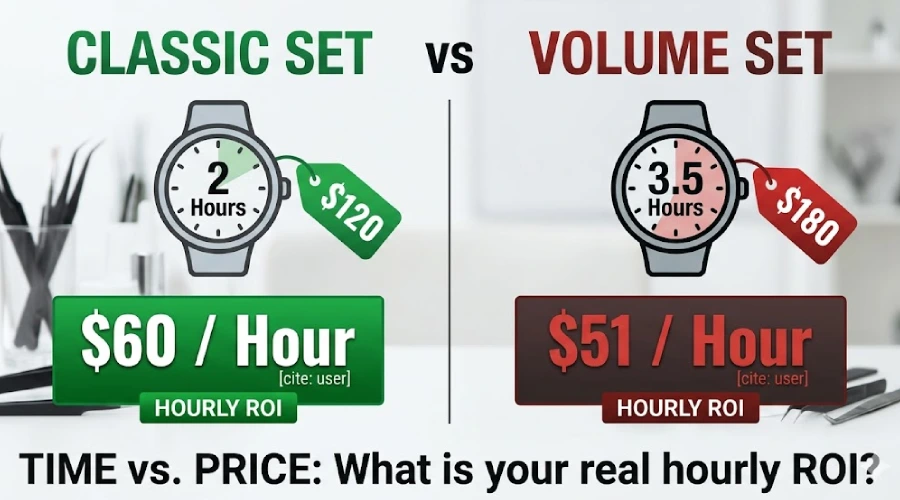
For example, a classic full set priced at $120 and finished in two hours brings in $60 per appointment hour. A volume full set priced at $180 but finished in three and a half hours brings in about $51 per appointment hour.
On paper, volume is the higher-ticket service. In the schedule, it may be less profitable.
This does not mean salons should avoid volume lashes. It means volume should not be added to the menu just because competitors offer it. Volume becomes profitable only when the math works.
Classic Lashes Are Not Outdated
Classic lashes are often treated as the entry-level service, but that does not make them weak. For many salons, classic sets are the service that keeps the calendar stable.
Classic lashes are easier for new clients to understand. They are natural, clean, and less intimidating than volume. First-time lash extension clients often choose classic because they do not want to look too dramatic. Office workers, mature clients, and natural-beauty clients may also prefer classic sets because the result feels wearable.
For technicians, classic lashes build the foundation. Isolation, placement, adhesive control, direction, distance from the eyelid, and lash mapping all become visible in a classic set. A salon that cannot produce clean classic work will struggle to build trust with more advanced services.
Classic is not the cheap service. It is the service that introduces clients to your salon, builds confidence, and creates a path toward hybrid or volume upgrades.
Volume Lashes Only Work When the Math Works
Volume lashes can be an excellent premium service, but only when the salon understands its real cost.
A salon should not price volume by copying a competitor’s menu. The competitor may have faster technicians, different rent, different product costs, or a different client base. Their price may not work for your business.
A simple way to look at service profitability is:
Revenue per appointment hour = service price divided by total appointment time.
If a classic full set takes two hours and a volume full set takes four hours, volume must be priced high enough to justify that time. If it is not, the salon is discounting the technician’s labor without realizing it.
This becomes even more important when the salon is busy. A long volume appointment may block two shorter services. The lost opportunity cost should be considered.
Volume lashes are premium only when the result, retention, timing, and price are all premium.
The Hidden Costs of Volume Lash Extensions
Material cost is only one part of volume lash pricing. The larger cost is usually time and skill.
Volume may require more training, more practice, and more correction. Handmade fans take time. Poor fan control leads to uneven results. Too much adhesive can affect retention. Fans that are too heavy can damage natural lashes. If the client returns with poor retention, the salon may spend unpaid time fixing the set.
There is also consultation time. Some clients ask for a dramatic look without understanding whether their natural lashes can support it. A good technician must explain safe weight, lash health, and realistic results. That expertise should be reflected in the service price.
Cheap volume trays or low-quality premade fans can also create hidden costs. If the base is too bulky, the technician needs more time to attach it cleanly. If the fans are inconsistent, the final set looks uneven. If pickup is difficult, every appointment becomes slower.
A low-cost tray can become expensive if it adds twenty minutes to every service.
When Volume Lashes Become Profitable
Volume lashes become profitable when the salon can deliver them consistently within a controlled time.
That usually means the technician is properly trained, the fan quality is stable, the service price covers the appointment time, and the client understands what they are paying for. Retention should be predictable. Refills should not become constant repair sessions.
A profitable volume service also needs the right client. Not every client needs volume. Not every natural lash line can support the same fan size. If the salon applies volume to everyone just to sell a higher service, the result can be poor retention and damaged trust.
Volume should be sold as a controlled premium result, not as “more lashes for more money.” The salon is not only selling fullness. It is selling skill, safety, symmetry, and long-term wear.
Premade Fans Are Not Cheating

Some lash artists still treat premade fans as a shortcut. For salon owners, that view is too narrow.
Premade fans are not cheating. They are a business decision.
If high-quality premade fans help a salon reduce service time, maintain consistent results, train technicians faster, and serve more clients without lowering quality, they can make volume services more profitable.
The key is quality. A good premade fan should have a neat base, light weight, consistent spread, and easy pickup. A poor premade fan can slow the technician down and create poor retention.
Handmade fans still have value, especially for advanced artists and customized work. But a salon menu should be built around consistent delivery, not pride. If premade fans help your salon deliver safe, beautiful, repeatable volume sets, they belong in the business conversation.
When You Should Not Offer Volume Yet
If your salon does not have a volume-trained technician, do not rush to put volume on the menu.
Poor volume work can hurt your reputation faster than not offering volume at all. Clients will not blame your training process, lash trays, or supplier. They will blame your salon.
A volume set with too much weight can damage natural lashes. A messy fan base can affect comfort. Weak retention can make clients believe volume lashes are a bad service, when the real issue is poor technique or poor product quality.
Before offering volume, make sure your team can control isolation, fan weight, adhesive amount, placement, and refill work. If not, start with classic and hybrid. Build skill first. Add volume when the salon can deliver it confidently.
Do not let your competitors pressure you into selling a service your team cannot yet protect.
Which Clients Should Still Start With Classic
Classic lashes are still the best starting point for many clients.
A first-time lash extension client may not know how much fullness she wants. Classic gives her a clean, natural result without making the first experience feel too dramatic. It also gives the technician a chance to understand her natural lashes, lifestyle, retention pattern, and maintenance habits.
Classic is also a smart recommendation for clients who prefer soft beauty, work in professional settings, or have enough natural lashes to create visible definition with one-to-one application.
From a salon strategy perspective, classic can reduce decision pressure. Once the client trusts your work, it becomes easier to recommend hybrid or light volume later.
A client who starts with classic and returns regularly may be more valuable than a one-time volume client who never rebooks.
Hybrid Is Often the Most Profitable Middle Ground
Hybrid lashes are often overlooked in the classic vs volume discussion, but they can be one of the most practical services on a salon menu.
Hybrid gives clients more texture and fullness than classic without the time and intensity of full volume. It is easier to position as an upgrade because the result is visible but still wearable.
For salons, hybrid can improve profit because it often has a higher price than classic while staying more time-efficient than full volume. It also gives lash artists flexibility. They can use classic extensions for structure and volume fans for fullness, texture, or sparse areas.
Hybrid is especially useful for clients who want wispy looks, soft glam, or a fuller lash line without committing to a dramatic volume set.
If classic is your foundation and volume is your premium service, hybrid is the bridge that helps clients move upward.
How to Build a Smarter Salon Lash Menu
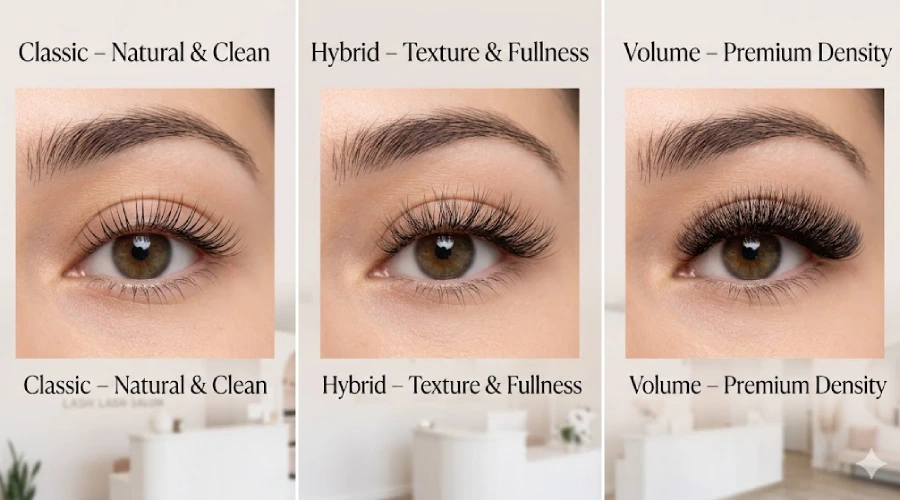
A strong lash menu should guide clients instead of confusing them.
Classic should be positioned as the clean, natural foundation. It is ideal for first-time clients and everyday wear.
Hybrid should be positioned as the most flexible upgrade. It gives more texture and fullness without becoming too heavy.
Light volume can be positioned as a soft premium service for clients who want density but still prefer a refined look.
Full volume should be reserved for clients who want a fuller result and are willing to pay for the extra time and skill.
Mega volume should only be offered if the salon has trained technicians, proper products, and clients whose natural lashes can safely support the look.
This structure helps the salon avoid selling every service to every client. It also makes consultation easier. The question becomes not “Which style do you want?” but “Which result fits your lashes, lifestyle, and maintenance plan?”
Lash Tray Quality Can Decide Your Profit
Product quality directly affects salon profit. This is especially true for volume services.
If classic trays have inconsistent curl or poor strip quality, technicians lose time during application. If volume fans are uneven, heavy, or hard to pick up, the service becomes slower. If premade fans have bulky bases, retention may suffer.
These small product issues create real business costs. A technician who loses fifteen to twenty minutes per appointment because of difficult trays may reduce the salon’s daily earning capacity. A client who comes back with retention problems may require unpaid correction time.
For salons, the cheapest lash tray is not always the lowest-cost tray. The better tray is the one that helps technicians work faster, cleaner, and more consistently.
When choosing lash extension trays, check curl consistency, pickup ease, base quality, fiber softness, and repeat order stability. A salon needs products that perform the same way every week, not only samples that look good once.
A Simple Decision Framework for Salon Owners
| Situation | Recommended Action | Business Goal |
|---|---|---|
| Classic lashes generate higher revenue per appointment hour than volume lashes. | Promote Classic confidently. Do not treat it as a low-value or “entry-level” service on your menu. | Maximize Hourly ROI |
| Volume sets are taking too long and hurting your daily turn-around rate. | Stop pushing it temporarily. Review your pricing structure, technician training, fanning methods, and product quality immediately. | Optimize Time Efficiency |
| Technicians are struggling or slowing down with handmade fans. | Test high-quality premade fans. Transitioning can instantly improve timing and set consistency. | Standardize Quality & Speed |
| Clients want more fullness and density but are not ready for full volume sets. | Recommend Hybrid lashes and position them as the perfect seamless upgrade option. | Increase Average Ticket Value |
| Volume clients are complaining about poor retention. | Audit your technical execution carefully. Check fan weight, adhesive control, natural lash health, aftercare compliance, and lash tray quality before blaming the client. | Secure Client Retention |
| Your team cannot deliver volume sets safely and consistently yet. | Delay offering the service until your technicians are fully prepared. Protecting your salon reputation matters more than selling a premium service too early. | Protect Brand Reputation |
Final Thought: The Best Service Is Not the Most Expensive One
The most profitable lash service is not always the one with the highest price on the menu.
The best service is the one your salon can deliver consistently, price correctly, and refill reliably. For many salons, classic lashes are the steady foundation. Hybrid lashes are the easiest upgrade. Volume lashes are the premium service, but only when the timing, training, product quality, and pricing all support it.
Do not build your lash menu around what sounds expensive. Build it around what actually works in your schedule, with your technicians, for your clients.
A profitable salon does not sell volume because everyone else does. It sells volume when it can deliver a result worth the price.
FAQs
Are volume lash extensions always more profitable than classic?
No. Volume lashes often have a higher service price, but they also take more time and skill. If the appointment time is too long, classic may bring higher revenue per hour.
Should beginner lash techs start with classic lashes?
Yes. Classic lashes help beginner technicians learn isolation, placement, adhesive control, direction, and lash mapping. These skills are necessary before moving into volume work.
Are premade fans bad for professional salons?
High-quality premade fans can help salons improve speed and consistency. They are not cheating. They are a business tool when used correctly.
When should a salon add volume lashes to the menu?
A salon should add volume when technicians can deliver safe, consistent results, control fan weight, maintain good retention, and complete the service within a profitable appointment time.
Is hybrid more profitable than volume?
Hybrid can be very profitable because it often supports a higher price than classic while taking less time than full volume. The exact profit depends on your salon pricing and technician speed.
What is the biggest mistake salons make with volume lashes?
The biggest mistake is pricing volume based only on competitors. Salons should calculate appointment time, technician skill, product cost, refill behavior, and correction risk.
How can salons choose better lash extension trays?
Check curl consistency, pickup ease, fiber softness, base quality, and repeat order stability. A tray that saves technician time can be more valuable than a cheaper tray.