

Ordering cluster lash samples is not just a small step before a wholesale order. For a lash brand, it is the first real test of whether a manufacturer can support your product line.
Photos can make almost any lash tray look attractive. A catalog can show many styles. A low price can sound tempting. But when the sample arrives, you can finally check the details that affect customer reviews: softness, curl, length accuracy, pickup stability, tray layout, packaging protection, and product consistency.
From a manufacturer’s point of view, a good sample order helps both sides. The buyer can test quality and market fit. The factory can understand the buyer’s preferred style, packaging needs, and target price range. If this step is handled carefully, it can prevent many problems before bulk production begins.
Why Cluster Lash Samples Matter Before Bulk Orders

Cluster lashes are small products, but customers notice the details quickly. A cluster may look good in the tray but still feel too stiff, too heavy, or difficult to pick up.
For a new lash brand, sample testing reduces risk. You can check whether the style matches your market before investing in packaging and inventory. For an established brand, samples help confirm whether a new manufacturer can match your existing standard.
Many bulk order problems start because the sample stage is rushed. Some buyers only check product photos. Some approve samples without testing pickup. Some forget to test packaging protection. When the bulk order arrives, small differences in curl, tray layout, or root quality become expensive problems.
A professional manufacturer should take the sample stage seriously. It is better to spend extra time confirming the right sample than to rush into production with unclear standards.
Cluster Lash Sample Testing Checklist
Before reading the full guide, use this quick checklist when your samples arrive.
Fiber softness: The lashes should feel soft, flexible, and not plastic-like.
Comfort: The root should not feel sharp, bulky, or stiff.
Curl consistency: Several trays placed side by side should not show obvious curl differences.
Length accuracy: Random checks should stay close to the marked length. A tolerance around plus or minus 1 mm is usually workable.
Pickup stability: Use tweezers to pick up the same cluster about ten times. It should not split or fall apart.
Root quality: The base should be neat, not heavy with visible glue.
Tray layout: Rows should be clean, straight, and easy to understand.
Packaging protection: After light shaking, the tray should not become messy.
Pre-glued stability: The adhesive should not be too dry, too sticky, or exposed to poor sealing.
Document support: For adhesive-related products, ask what safety or material documents are available.
What to Prepare Before Requesting Samples
Before asking a factory to send cluster lash samples, prepare a clear request. It does not need to be complicated. It only needs to help the manufacturer understand what you are trying to build.
If you only say “send me your best cluster lashes,” the factory may send popular styles. But popular styles may not match your customers. A brand selling soft daily lashes needs different samples from a brand selling dramatic manga clusters. A salon buyer may care more about application control. An online beauty brand may care more about beginner-friendly styles, packaging, and product photos.
The most useful information includes your target market, sales channel, preferred lash effect, expected order quantity, and private label needs. If you plan to sell DIY lash extension kits, mention whether you also need bond, seal, remover, tweezers, spoolies, or kit boxes.
Clear information helps the factory avoid random samples. It also helps you judge whether the supplier understands your business.
Which Cluster Lash Samples Should You Test First?
For a first sample order, test a focused group of styles. Do not order too many at once. Four to six styles are usually enough for a new brand.
A practical sample set may include one natural style, one wispy style, one cat eye style, one manga or spiky style, and one brown cluster style if your market likes softer looks. If your brand wants an easy-application line, you can add pre-glued cluster lashes. These need extra testing because the adhesive layer adds storage and stability risks.
The goal is not to see everything the factory can make. The goal is to find out whether the factory can make the styles your customers are most likely to buy.
Stock Samples and Custom Samples Are Not the Same
Stock samples are existing styles that the manufacturer already produces. They are faster, usually cheaper, and useful for checking basic quality. If you are still comparing factories, stock samples are the right starting point.
Custom samples may involve adjusted length, curl, lash map, tray layout, packaging, logo printing, or kit combination. They take more time because the factory needs to confirm details and prepare materials or packaging proofs.
A common mistake is asking for full customization before checking the factory’s basic product quality. It is usually better to test stock quality first. If the fiber, curl, root, and tray quality are acceptable, then move to custom packaging or custom lash maps.
This approach saves time. It also helps you avoid custom development with a factory that may not meet your quality expectations.
How to Check Lash Fiber Softness and Comfort
Softness is one of the first things to test when the samples arrive. Do not judge only by appearance. Touch the lash tips and root area with your fingers. Good cluster lashes should feel flexible and light, not hard or plastic-like.
DIY users apply clusters under their natural lashes. A bulky or stiff root can cause irritation. Comfort is not optional.
A simple way to compare samples is to place several styles side by side and touch them one by one. You will quickly feel which sample is softer, lighter, or more flexible. If you have testers, ask them to apply the samples and report how the clusters feel after several hours.
From a factory perspective, softness is related to fiber material, production technique, root treatment, and style density. Dramatic styles can still be comfortable, but the manufacturer needs good control over weight and root structure.
How to Test Curl, Length and Thickness Consistency
Curl and length consistency are important because customers expect the tray to match the label. If a 12 mm row looks close to 14 mm, the product will look unreliable.
Randomly select several clusters from each row and measure them with a ruler or caliper. For many lash products, a length tolerance around plus or minus 1 mm is workable. The key is visual consistency within the same tray and the same batch.
Curl should also be checked across multiple trays. Put the samples on a flat surface and compare the side profile. A small natural variation is normal. One tray should not look lifted while another looks flat if they are supposed to be the same style.
Thickness is harder to measure without tools, but you can still compare visual density and weight. If one sample feels much heavier than others in the same style category, it may not be suitable for beginner-friendly DIY lashes.
How to Check Whether Cluster Lashes Fall Apart
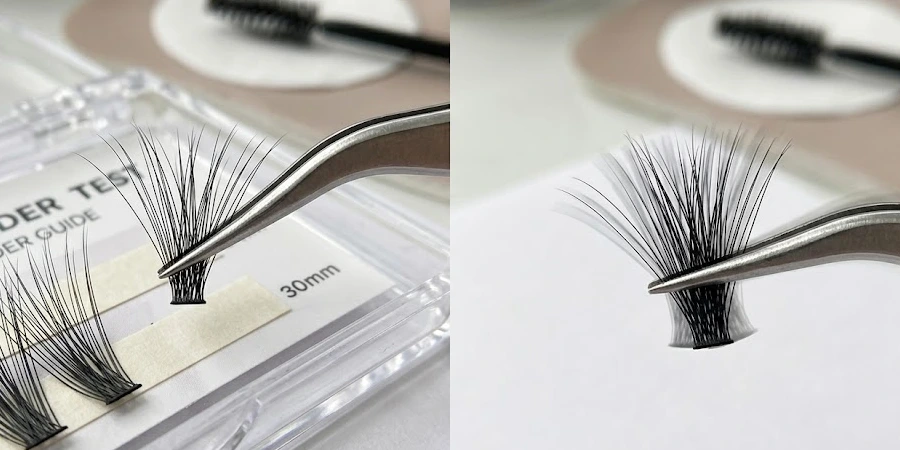
Pickup stability is one of the most important tests for cluster lashes. A customer may forgive a small packaging issue. They will not accept clusters that break before application.
Use tweezers to pick up the same cluster several times. A simple factory-style test is to pick and release one cluster about ten times. Watch the root. The cluster should keep its shape. It should not split open, lose fibers, or become messy during normal pickup.
Also check how easily the cluster leaves the tray. If it sticks too strongly, customers may damage it while removing it. If it comes off too loosely, the tray may look messy after shipping.
The root area should be neat. Too much visible glue can make the cluster look cheap and uncomfortable. Too little bonding can make the cluster unstable.
The best sample is not always the prettiest one in the tray. It is the one that can survive normal customer handling.
How to Evaluate Tray Layout and Presentation
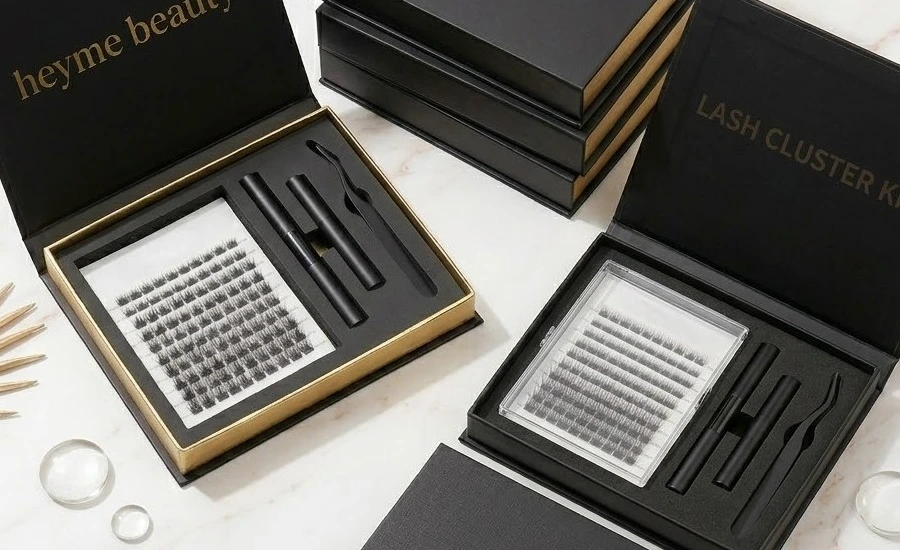
Tray layout affects both user experience and brand image. When customers open the product, the tray is the first thing they see. A clean tray makes the product feel professional. A messy tray makes even good lashes feel low quality.
Check whether the rows are straight, whether the lengths are clearly separated, and whether the clusters are easy to pick up. For mixed-length trays, the arrangement should be logical. Customers should understand which length to use for the inner corner, middle, and outer corner.
Lightly shake the package and check the tray again. This shows whether the clusters stay in position during shipping. If the tray becomes messy too easily, you may need stronger tray fixing, better packaging protection, or a different tray structure.
For private label products, tray presentation matters. Customers connect it with your brand quality. A factory should understand that the tray is not just a container. It is part of the retail experience.
How to Test Pre-Glued Cluster Lash Samples
Pre-glued cluster lashes need more careful testing than regular cluster lashes. The adhesive layer creates convenience, but it also creates extra risk.
First, check whether the glue layer is even. It should not be too dry, too wet, or unevenly distributed. If the adhesive is too weak, customers will complain that the lashes do not stay on. If it is too sticky or messy, application becomes difficult.
Storage and shipping conditions are also important. Pre-glued products may be affected by temperature, humidity, and packaging seal. Ask the manufacturer whether the product has been tested after transportation simulation or under different storage conditions.
Packaging is especially important for pre-glued clusters. The product should be sealed well enough to protect the adhesive from dust, moisture, and drying. Poor sealing can change the glue before the customer uses it.
For brands selling pre-glued products, ask for adhesive-related documents or ingredient information. This does not replace your own compliance responsibility, but it helps you understand whether the manufacturer has basic control over the product.
Should You Test Packaging Samples Too?
If you plan to sell private label cluster lashes, packaging should be tested during the sample stage. Do not wait until every product detail is finished.
Packaging problems can delay production more than many buyers expect. Logo color may not match the design file. The box may be too thin for shipping. The tray may move inside the package. The instruction card may not fit. A barcode or label area may be missing.
Ask for packaging mockups or physical packaging samples when possible. Check printing clarity, color, material thickness, box structure, and product protection.
For DIY lash extension kits, packaging needs more attention. Lash trays, bond, seal, tweezers, remover, and small tools should not move loosely inside the box. A kit can look beautiful in photos but feel cheap if the items are not fixed properly.
Good packaging is not only decoration. It protects the product, explains the style, supports retail display, and builds customer trust.
What Documents Should You Ask for With Samples?
For simple false eyelashes, buyers often focus on style and packaging. But if your product line includes bond, seal, remover, glue, pre-glued clusters, or other adhesive-related items, documents become more important.
Depending on your market and product type, you may need material information, MSDS, ingredient details, heavy metal testing, formaldehyde-related testing, or other safety reports requested by importers, retailers, or marketplaces.
For the European market, some cosmetic-related products may involve CPNP requirements. For the US market, buyers should understand FDA-related cosmetic responsibilities where applicable. Exact requirements depend on product type and sales channel, so brands should confirm with their importer, compliance consultant, or marketplace policy.
A manufacturer cannot take over all legal responsibility for your brand. But a professional factory should be able to provide basic product information and explain what documents are available.
If a supplier cannot clearly answer questions about materials or adhesive-related documents, be careful before placing a large order.
How Many Samples Should You Order?
There is no single correct number. The sample order should be large enough to test quality properly.
If you are a new brand, four to six cluster lash styles are usually enough for the first round. This gives you a clear view of the factory’s quality without making the decision too complicated.
If you already sell lashes and are looking for a new supplier, you may test more styles. You need to compare them with your existing products. In this case, eight to twelve styles may be reasonable.
If you plan to sell pre-glued cluster lashes or DIY lash extension kits, order more than one sample unit. You need to test application, storage, packaging, and consistency across multiple pieces. One good-looking sample is not enough to prove that the product is ready for bulk sales.
How to Compare Samples From Different Manufacturers
When comparing samples, do not choose only by price. The cheapest sample may not give you the lowest business risk.
Compare the samples as if you were the customer. Which tray looks more professional when opened? Which cluster is easier to pick up? Which style looks closer to the product photo? Which sample feels softer? Which factory communicates more clearly when you ask technical questions?
Also compare the manufacturer’s response during the sample process. A good factory will ask questions, confirm details, explain limitations, and suggest practical solutions. A weak supplier may only send a price and avoid detailed discussion.
The sample shows product quality. The communication around the sample shows whether the factory can support future orders.
Common Mistakes When Ordering Cluster Lash Samples
One common mistake is approving samples too quickly. Buyers may look at the tray, like the style, and move directly to bulk production. But cluster lashes need handling tests, application tests, and packaging checks.
Another mistake is testing too many styles at once. When a brand receives twenty different samples, it becomes harder to decide what to launch. A focused first round is usually more useful.
Some buyers also forget to confirm production details in writing. Once you approve a sample, the factory should understand exactly which curl, length, root, tray layout, and packaging details need to be repeated in bulk production.
Pre-glued products create another common mistake. Buyers may treat them like regular cluster lashes, but adhesive stability, packaging seal, storage condition, and shelf life should all be checked before bulk order.
Hidden costs should also be discussed early. Sample fees, shipping fees, packaging proof fees, printing plate fees, mold fees, artwork revision fees, and special material costs can affect the real order budget.
What to Confirm Before Moving to Bulk Production
Before placing a bulk order, confirm the final production details in writing. These should include style name, curl, length, thickness, tray layout, packaging artwork, quantity, MOQ, unit price, lead time, shipping method, and quality requirements.
If there is custom packaging, confirm the logo file, box material, printing color, barcode position, label content, and any instruction card. If there are adhesive-related products, confirm documents, storage instructions, and shelf life information where applicable.
It is also helpful to ask the factory to send pre-production photos or videos before full production. This gives both sides one more chance to catch mistakes before the order is completed.
A bulk order should not begin with assumptions. It should begin with confirmed standards.
Conclusion
A cluster lash sample order is small in quantity, but it carries a lot of information. It shows whether the manufacturer understands quality, whether the product is suitable for your market, whether the packaging supports your brand, and whether the factory can communicate clearly.
For lash brands, the best sample is not simply the most beautiful tray. It is the sample that can be repeated in bulk production with stable quality.
Take time to test softness, curl, length, pickup stability, tray layout, packaging, and compliance support before ordering in bulk. If a sample already shows problems, do not expect mass production to become better by itself.
A reliable cluster lash manufacturer should be willing to work through this process with you. The goal is not just to ship samples. The goal is to create a product your customers can trust and buy again.
FAQs
Should I order cluster lash samples before bulk production?
Yes. Samples help you check real product quality before investing in bulk inventory or private label packaging. They also help confirm whether the manufacturer can meet your expected style and quality standard.
How many cluster lash samples should a new brand test?
For a new brand, four to six styles are usually enough for the first round. This may include natural, wispy, cat eye, manga, brown, or pre-glued cluster lashes depending on your target market.
Can I order private label packaging samples?
Yes. Many manufacturers can provide packaging mockups or physical packaging samples. If you plan to build a branded lash line, packaging should be checked before bulk production.
How do I test if cluster lashes fall apart easily?
Use tweezers to pick up and release the same cluster several times. Around ten pickup attempts can show whether the root stays stable. If the cluster splits or loses shape during normal handling, it may not be suitable for bulk order.
Are pre-glued cluster lash samples harder to test?
Yes. Pre-glued cluster lashes require extra checks for adhesive stability, packaging seal, storage conditions, shelf life, and transportation performance. They should not be tested only by appearance.
Can the sample be used as the bulk production standard?
Yes. The approved sample should be used as the reference for bulk production. This helps control curl, length, tray layout, root quality, and packaging details.