

Most lash cluster sellers on Amazon don’t fail because their product is bad.
They fail because customers don’t understand what they are buying—or worse, they understand it differently from what the seller intended.
On Amazon, confusion is expensive. It shows up as low conversion rate, weak ad performance, and unstable repeat orders.
That is why positioning is not branding decoration. It is the foundation of how your lash product behaves in the market.
At Heyme Beauty, as a private label lash cluster manufacturer, we see this pattern constantly: two sellers can use similar lash styles, but one scales, while the other gets stuck fighting price pressure. The difference is rarely production—it is positioning discipline.
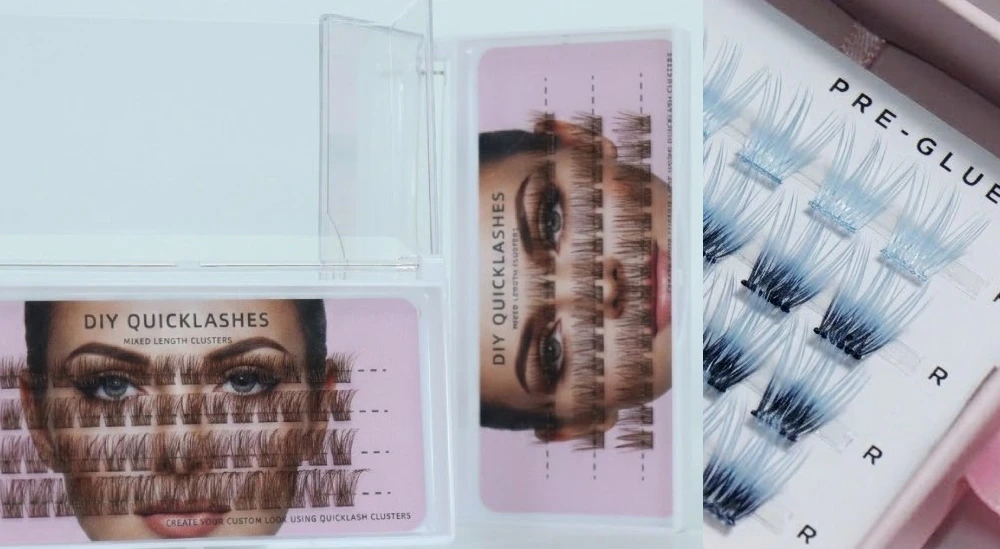
What Positioning Actually Means on Amazon
In real Amazon operations, positioning is not a concept—it is a system.
It defines:
- who clicks your listing
- who trusts your price
- who leaves a review
- who buys again
In the lash cluster category, positioning is built from five practical signals:
- Product style (natural, hybrid, glam)
- Price expectation (entry, mid, premium)
- Visual identity (clean, soft, bold, luxury)
- Customer use case (daily wear vs occasion makeup)
- Perceived quality (not just actual quality)
Two listings can use the same “C curl natural cluster,” but if one looks like a daily-use product and the other looks like a premium beauty item, they will perform completely differently on Amazon.
As a manufacturer, we can help you produce best-selling eyelash styles for Amazon.
The Three Positioning Paths That Actually Work on Amazon
Most successful lash cluster brands fall into one of three stable directions. Problems usually start when sellers mix them.
Entry Natural Positioning (Volume Driven)
This is the easiest entry point, but also the most competitive.
Typical buyer:
- first-time lash users
- price-sensitive shoppers
- fast decision behavior
Product behavior:
- simple natural styles
- lower perceived complexity
- cost-efficient packaging
Amazon reality:
- high traffic potential
- low differentiation
- aggressive price competition
Operational note:
Many sellers start here, then try to “upgrade” too late after facing margin pressure.
Everyday Glam Positioning (Stability Zone)
This is where most sustainable Amazon lash brands operate.
Buyer profile:
- repeat users
- working professionals
- buyers who care about comfort + appearance balance
Product logic:
- balanced lash density
- improved curl consistency
- more refined tray and packaging design
Amazon behavior:
- more stable conversion rate
- better repeat purchase signals
- stronger review consistency
Operational note:
This segment is less about viral sales and more about predictable revenue.
Premium Lash Cluster Positioning (Brand-Led)
This is where perception matters as much as product performance.
Buyer profile:
- beauty-conscious users
- influencer-driven traffic
- customers willing to pay for experience
Product expectations:
- refined fiber quality
- consistent curl structure
- stronger visual identity
- packaging as part of the product
Amazon behavior:
- higher CPC tolerance
- stronger brand recall
- slower but higher-value scaling
Operational note:
Premium positioning fails quickly if packaging and product experience are not aligned.
How a Manufacturer Supports Each Positioning Path
| Dimension | Entry Natural Positioning | Everyday Glam Positioning | Premium Lash Cluster Positioning |
|---|---|---|---|
| Core Goal | Cost control + fast reorder | Quality consistency + repeat purchases | Exclusive experience + brand premium |
| Product Development | Ready-to-use natural templates (C curl, light density) | Standardized curl & density parameters for batch consistency | Exclusive designs, no public molds, custom curl mixes & layered density |
| Fiber Material | Cost-effective PBT, no over-engineering | Upgraded silk-finish PBT, balance of feel & cost | High-end silky fibers or imported materials, visibly premium |
| Tray / Inner Case | Stock tray, functional only | Sturdy & easy-to-remove design for daily use | Custom tray designed for unboxing experience |
| Packaging | Stock white box + brand sticker (cost within 3-5% of retail price) | Branded color box with structured visual identity | Full package: magnetic box, foil/UV, EVA insert, cards, instruction guide |
| MOQ | 500–1000 boxes, low entry barrier | 1000+ boxes, supports mixed styles | Negotiated per style, accepts small batches with multiple sampling rounds |
| Lead Time | 7–10 days | 14–21 days | 30–45 days (including 3–5 sampling rounds) |
| Reordering Support | Keep raw material stock, ship within 15 days | Batch traceability, process parameters archived | Exclusivity agreements, no direct competitor sales |
Why Most Sellers Get Positioning Wrong on Amazon
In real operations, positioning mistakes are rarely obvious at the beginning.
They usually appear after launch.
Common failure patterns:
- listing targets everyone, but converts no one
- product looks premium, but pricing looks entry-level
- packaging looks luxury, but product feels generic
- multiple styles mixed in one store without direction
One typical scenario:
A seller launches 6 lash styles to “test the market.”
Amazon’s algorithm treats the store as unclear positioning.
Traffic spreads thin, reviews are inconsistent, and no product dominates.
Result: no winning SKU emerges.
How Positioning Directly Impacts Amazon Performance
Positioning is not abstract—it directly affects how Amazon evaluates your listing.
Keywords behave differently
- natural positioning → “soft lashes”, “daily lash clusters”
- glam positioning → “volume lash clusters”, “dramatic lashes”
- premium positioning → “luxury lash clusters”, “salon effect lashes”
If keywords and positioning mismatch, traffic quality drops immediately.
Conversion rate is positioning-dependent
Amazon buyers decide in seconds:
- Does this look like my type of lash?
- Is this too cheap or too expensive for me?
- Do I trust this brand?
Even strong products fail if they “feel wrong” for the target buyer.
Ads amplify positioning errors
Paid traffic does not fix weak positioning—it exposes it faster.
- Entry products rely on CTR efficiency
- Premium products rely on trust and perceived value
- Mixed positioning leads to unstable ACOS
Many sellers misinterpret this as “bad ads,” when it is actually positioning mismatch.
Product Development Must Follow Positioning (Not the Other Way Around)
In manufacturing reality, positioning defines product structure.
At Heyme Beauty, when we develop private label lash clusters, key adjustments depend entirely on positioning:
- lash density (light vs layered volume)
- curl type selection (C / CC / D mix)
- fiber finish (soft matte vs silk-like shine)
- reuse expectation (short-cycle vs long-cycle wear)
- tray layout design (simple vs structured SKU system)
A “premium lash” and a “natural lash” are not just styling differences—they are different production decisions.
Packaging Is Not Decoration—It Is Positioning Confirmation
On Amazon, packaging is often the first proof of your positioning.
It either confirms or destroys customer expectations.
Mismatch examples we often see:
- luxury box + low-end lash quality → trust loss
- basic packaging + premium pricing → conversion drop
- inconsistent branding across SKUs → weak brand memory
Good positioning alignment feels simple:
- entry level → clear, minimal, functional
- mid-tier → structured identity
- premium → experience-driven unboxing
Pricing Follows Positioning
Many sellers calculate price like this:
Cost + Amazon fees + margin = retail price
That is operationally correct—but strategically incomplete.
Positioning changes pricing power.
- entry positioning → price-sensitive competition
- mid positioning → balanced value perception
- premium positioning → perception-driven pricing tolerance
When pricing contradicts positioning, customers hesitate—even if the product is good.
What Happens When Positioning Is Done Correctly
When positioning is clear, Amazon performance becomes predictable:
- listing attracts the right audience
- ads become easier to optimize
- reviews align with expectations
- repeat purchase increases naturally
More importantly, you stop competing on “product features” and start competing on “market perception.”
That is where real brand value begins.
How Heyme Beauty Supports Amazon Lash Brand Positioning
As a lash cluster manufacturer working with private label brands, Heyme Beauty supports more than production.
We help brands align positioning with real product execution:
- custom lash design based on target market direction
- density and curl adjustment for positioning accuracy
- packaging development aligned with Amazon conversion behavior
- sample testing for different market entry strategies
- scalable MOQ for early-stage positioning validation
In many cases, the product is not the problem. The missing piece is alignment between market expectation and factory output.
Conclusion
On Amazon, success is not about having more products.
It is about making fewer, clearer decisions—and sticking to them.
Strong lash brands do three things consistently:
- define positioning before sourcing
- build products around one clear buyer type
- avoid mixing signals in listing, packaging, and pricing
Because in the end, positioning is not marketing.
It is how your customer decides whether you are for them—or not.